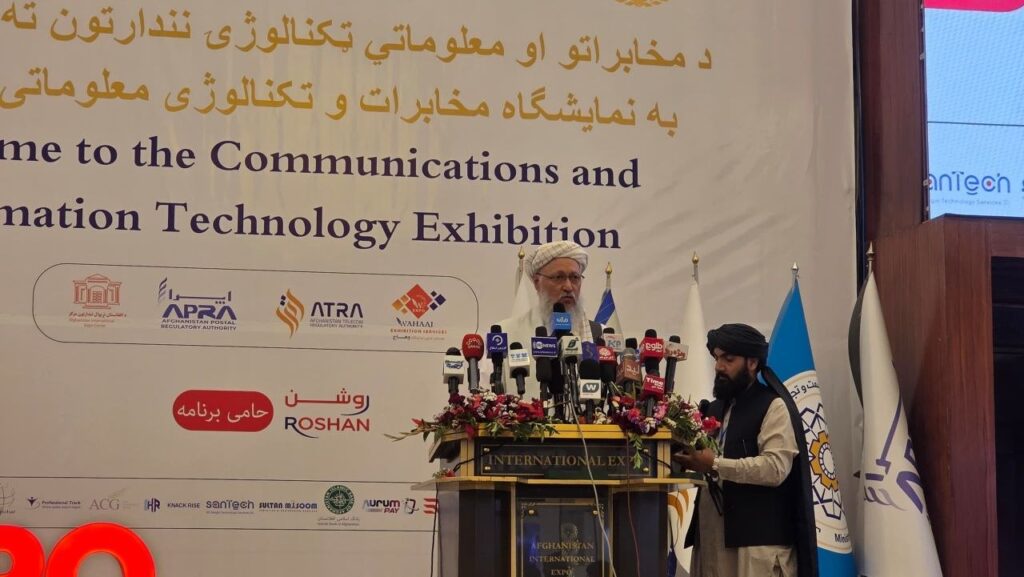
According to Iraf, the Taliban on Sunday inaugurated Afghanistan’s first five-day Telecommunications and Information Technology Exhibition in Kabul, where senior officials highlighted efforts to expand digital infrastructure, improve telecommunications services, and advance e-governance, despite continued criticism over internet restrictions and limited access to information.
The exhibition, organized by the Taliban’s Ministry of Communications and Information Technology, brings together technology firms and industry stakeholders to showcase emerging technologies, digital innovations, and developments in Afghanistan’s telecommunications sector.
Speaking at the opening ceremony, Deputy Prime Minister for Economic Affairs Abdul Ghani Baradar described technology as a key driver of economic growth and said the Taliban administration is seeking to gradually make Afghanistan more competitive in the field.
Baradar said the Ministry of Communications had been instructed to digitize government records and develop the infrastructure needed to expand electronic governance. He also claimed that telecommunications services have been extended to many previously underserved areas since the Taliban returned to power in 2021, with network capacity also increasing.
Deputy Prime Minister for Administrative Affairs Abdul Salam Hanafi said the telecommunications sector had made “significant progress,” adding that 400 telecommunications sites had been activated in remote parts of the country. He said efforts to expand network coverage, digitalize public administration, and modernize government systems would continue.
According to Taliban officials, several telecommunications and information technology projects have been approved in recent months, including investments in communications infrastructure, network expansion, power supply, and digital services. In April, the Taliban’s National Procurement Commission approved 19 development projects worth $44 million, part of which was allocated to telecommunications infrastructure.
The Ministry of Communications has also signed an agreement with the National Statistics and Information Authority to host servers for digital identity cards, support a new electronic national ID issuance system, and establish a warehouse management platform at the National Data Center as part of its broader digital governance strategy.
Earlier this year, the ministry announced the trial launch of fifth-generation (5G) mobile services in Kabul. The pilot project includes upgrading 74 telecommunications towers to 5G technology and constructing dozens of additional sites, with plans to expand the service to other provinces if the trial proves successful.
While the Taliban has promoted these initiatives as evidence of technological progress, independent analysts say a lack of transparency in telecommunications projects, damaged infrastructure, information monopolization, and restrictions on internet access continue to hinder sustainable digital development. They also warn that the Taliban’s policies on access to information raise ongoing concerns about the future of communications and media freedom in Afghanistan.