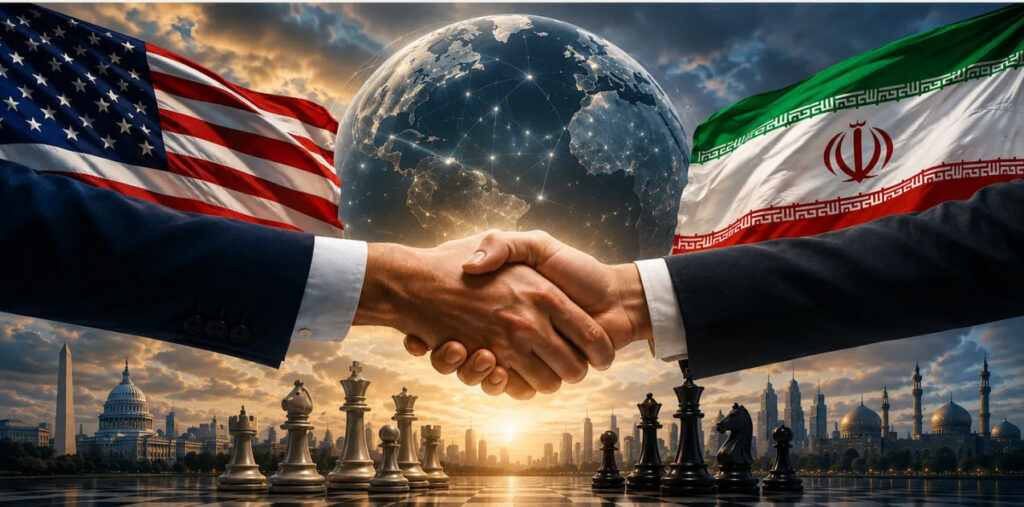
According to Iraf, the technical details and hidden layers of the initial memorandum of understanding between the Islamic Republic of Iran and the United States, signed in Geneva, indicate the formation of a conditional, stabilizing balance in the region.
This condensed document — whose digital negotiation process had been guided over recent months by special envoys such as Jared Kushner and Steve Witkoff — was finalized while Donald Trump was based in Paris and Masoud Pezeshkian in Tehran, though the commitments of both parties were entirely performance-based and were drafted in Switzerland.
According to the disclosed provisions, the central pillar of this 1.5-page memorandum rests on keeping the strategic Strait of Hormuz waterway open without the imposition of tolls, and the suspension of the American naval blockade, in exchange for a temporary and controlled adjustment of certain Iranian nuclear activities under agency monitoring.
This tactical compromise pushed Washington toward the negotiating table following the failure of the maximum-pressure project and the emergence of a severe economic and energy crisis in the West resulting from the war against Iran.
JD Vance, the U.S. Vice President, in an interview with CNN, while confirming these facts, noted that the memorandum would advance the commitments of both parties step by step, contingent on keeping the region’s main energy arteries open.
Amir Khan Muttaqi in Kabul: The Taliban’s Dream of Post-Sanctions Transit Openings
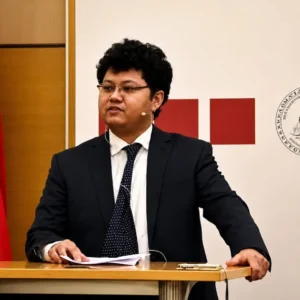
Amir Khan Muttaqi, the Taliban’s acting foreign minister, in an official statement welcoming the subsiding of military tensions in the region’s strategic waterways, described the agreement as a major opportunity to enhance the transit capacities of Central and South Asia.
Muttaqi, noting that stability in the Persian Gulf directly affects the economic security of the entire region, stressed that the Taliban government seeks the development of cross-border trade relations in an environment free of sanctions and pressure.
In this connection, The Washington Post reported that Kabul’s welcoming of the memorandum reflects the Taliban’s strong desire to activate economic corridors, particularly the connection to Iran’s Chabahar port.
Experts cited by the newspaper believe that reduced tension between Iran and the West would allow the Taliban’s Ministry of Public Works and other economic institutions in Kabul to advance their transit projects more rapidly, without fear of Washington’s secondary sanctions.
Western Media Analysis of Kabul’s Approach: A Transit Balance Minus Islamabad
Secondary analyses indicate that the Taliban’s view of this event goes beyond a simple diplomatic welcome. The Wall Street Journal noted that Kabul’s outlook on the agreement is accompanied by a degree of strategic calculation aimed at gaining access to open waters and reducing absolute economic dependence on Islamabad. Ongoing border tensions with Pakistan over the Durand Line and the issue of the Tehrik-i-Taliban Pakistan (TTP) have pushed Kabul toward diversifying its transit routes.
According to experts, Afghanistan’s growing economic engagement with Iran and the use of Chabahar port’s capacities serve as a safety valve for the Taliban government to bypass the constraints imposed by its eastern borders. The cooling of military tensions in the Persian Gulf would guarantee the long-term stability of this economic lifeline for Kabul.
Sergey Lavrov in Moscow: Explaining the Deadlock of Washington’s Maximum Pressure Doctrine
On the Eurasian front, Sergey Lavrov, Russia’s foreign minister, in a detailed statement, declared that the Geneva memorandum proves that Washington’s doctrine of maximum pressure and naval blockade has reached a dead end. Lavrov, referring to Moscow’s technical assessments, stressed that the agreement consolidates Iran’s legitimate right to preserve its strategic gains.
Moscow regards the recent understanding as evidence of the White House’s inevitable retreat under the pressure of public opinion and the fuel crisis in the West. From the Kremlin’s perspective, the consolidation of Iran’s regional authority and the step-by-step lifting of transit restrictions represent a major victory for the multilateralist approach across the Eurasian space.
Axios Decodes the Kremlin’s Position: Strengthening Convergence Within the Shanghai Cooperation Organization
The news and analysis outlet Axios, in an examination of Moscow’s position, reported that the Russians have based their calculations on the premise that the consolidation of Iran’s standing will help strengthen security convergence within the Shanghai Cooperation Organization and weaken asymmetric terrorist hubs in Afghanistan. This analysis suggests that Eurasia seeks to link Persian Gulf security to the security of Central Asia’s borders.
However, certain conservative circles in Washington have warned against this strategic overlap among Tehran, Moscow, and Beijing. The Washington Post disclosed that reports submitted by John Ratcliffe, Director of the CIA, indicate deep concern within America’s security establishment over the diminished effectiveness of sanctions tools across the Eurasian space following this agreement.
Xi Jinping in Beijing: Stability of the Strait of Hormuz and Securing China’s Energy Supply Chain
Xi Jinping, China’s president, during a meeting with senior diplomats in Beijing, described the stability of Persian Gulf and Strait of Hormuz energy routes as vital to global energy security and characterized the memorandum as a victory for multilateral diplomacy. Beijing believes that reliance on military instruments at the international level hinders the growth of Asia’s transit markets, and that the current opening is a beneficial step toward the medium-term interests of the global economy.
Guaranteeing the toll-free passage of oil tankers through the Strait of Hormuz has eased China’s concerns regarding energy security and smoothed the path for advancing the country’s major connectivity projects within the framework of the New Silk Road. Analyses published in Fox News and The Wall Street Journal also indicate that Beijing views this agreement as the primary stabilizing factor for its energy supply chain.
Narendra Modi in New Delhi: Chabahar’s Development and India’s Escape from the Secondary Sanctions Bind
Narendra Modi, India’s prime minister, along with senior officials of the country’s Ministry of External Affairs, issued a statement welcoming the calm restored to the world’s main energy arteries. New Delhi, which has traditionally maintained a delicate balance between its relations with Washington and its strategic investment in Iran’s Chabahar port, regards this memorandum as a green light for developing the next phases of this connective corridor.
Foreign Policy, in an analysis authored by subcontinent experts, wrote that India stands to gain the greatest peaceful economic benefit from this understanding in the long run. According to Foreign Policy, the lifting of the shadow of war and the reduced risk of naval blockade resolve New Delhi’s security concerns regarding energy supply and its competition with Pakistan’s Gwadar project. The new balance allows Modi to advance his projects without fear of Washington’s extraterritorial penalties.
Israeli Media: Acknowledging Tel Aviv’s Strategic Isolation and a Rift Within Trump’s Cabinet
Concurrent with these developments in Asian capitals, media outlets of the Israeli regime, in their latest analyses, have assessed the Washington-Tehran understanding as an intelligence and strategic failure for Tel Aviv. Haaretz, in a fact-based report, disclosed that Benjamin Netanyahu, the Israeli prime minister, during an emergency meeting of the security cabinet, expressed strong displeasure over the White House’s lack of full coordination with the regime and insisted on continuing independent military actions in Gaza and southern Lebanon.
However, analysts at Yedioth Ahronoth believe that Trump’s shift in approach and his preference for economic priorities over military adventurism have severely limited the Israeli regime’s operational maneuvering room on parallel fronts, placing Tel Aviv in a state of structural isolation. Separately, The Wall Street Journal disclosed that deep rifts have also formed within the U.S. cabinet, with Marco Rubio, the Secretary of State, and Pete Hegseth, the Secretary of Defense, expressing reservations about the memorandum.
Israel’s Kan Network: The Dollar’s Collapse and the Deadlock of the West’s Imposed Coalitions
Israel’s Kan news network, in a strategic report, also noted that the toll-free reopening of the Strait of Hormuz and the fall of the dollar’s price to the 162,000-toman mark on Iran’s free market indicate the failure of the American military’s naval blockade project and the diminished effectiveness of Israeli military pressure.
According to this Israeli outlet’s analysis, the Arab Persian Gulf capitals — which had previously made their bases available to the United States for potential confrontation as part of imposed coalitions — are now, in light of this memorandum, reconsidering the regional balance of power.
The combined positions of Muttaqi, Lavrov, Modi, and Xi Jinping, alongside the analyses of leading global media, indicate that the region’s new security arrangements are moving away from Tel Aviv’s coercive leverage and toward a homegrown, intra-regional structure within the Asian continent.