Persian Language and Literature Day offers an opportunity to revisit the importance of a language that has served for centuries as a major pillar of the cultural and literary heritage of Afghanistan, Iran, and the broader Khorasan civilizational region. Afghanistan has played a significant role in shaping and preserving this literary legacy. Today, however, Persian faces a range of political, cultural, and social challenges in the country.
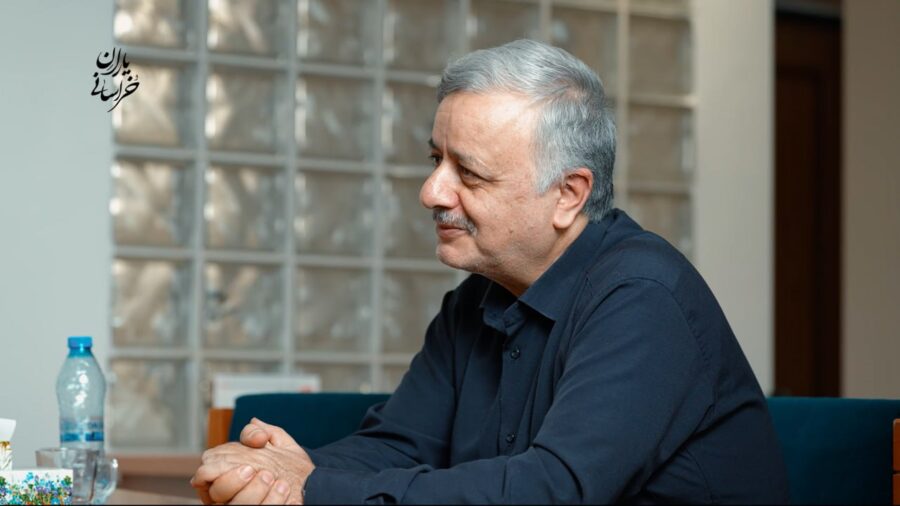
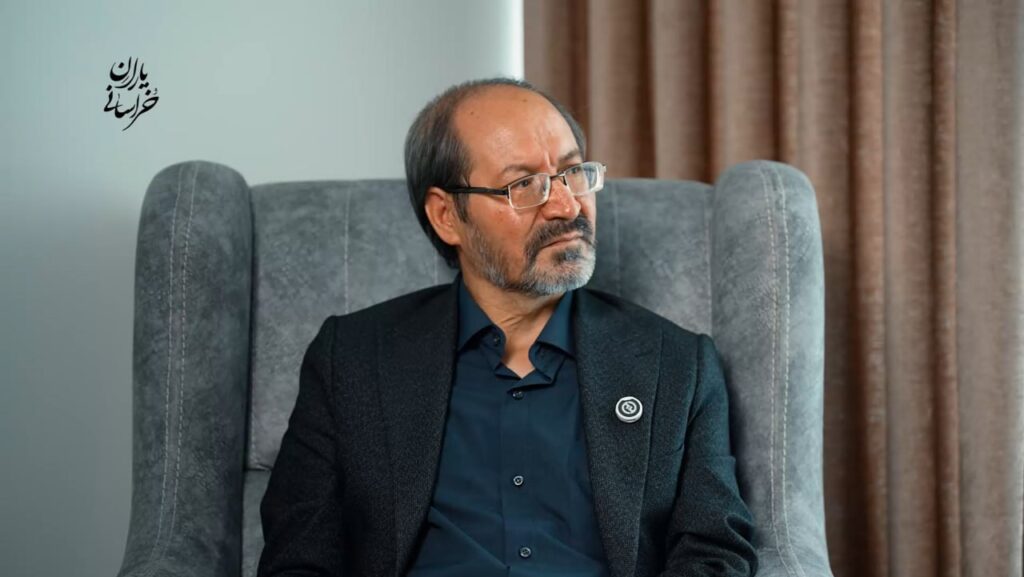
In an interview with IRAF TV’s “Yaran-e Khorasani” program, Afghan poet Seyyed Hakim Binesh discussed his experience attending a poetry gathering with the late Leader of the Islamic Revolution, his attention to Persian poetry and Afghan literature, and the current state of the Persian language in Afghanistan.
Binesh said the late leader’s interest in Persian poetry and literature went beyond encouraging poets, noting that his detailed knowledge of Afghan poetry, language, and literature demonstrated the particular importance he attached to the field.
He also expressed concern over the challenges facing Persian in Afghanistan, while emphasizing that poets and writers continue to work to preserve and strengthen the language.
A Memorable Encounter for a Poet
Reflecting on his participation in a poetry gathering with the late Leader of the Islamic Revolution, Binesh said: “I only had the honor of being in his presence once and reciting poetry in that warm gathering.”
Recalling the poem he performed at the meeting, he added: “This poem was about solidarity between the people of Iran and Afghanistan, and I had tried to include issues in it that would bring the hearts of the two nations closer together.”
The Afghan poet continued: “I was very happy that he liked the poem and encouraged me after almost every verse or couplet. It was truly a very good feeling for me, both at that moment and later, when I watched the footage of that meeting and heard his encouragement.”
Describing his emotions during the gathering, Binesh said: “Believe me, I felt a sense of pride, like a father who is happy with something his child has done and encourages him to do it again.”
Encouragement That Strengthened His Commitment to Poetry
Binesh said the meeting had a lasting effect on his poetic journey, explaining that although he was generally influenced by the atmosphere of the gatherings he attended, this particular encounter gave him additional motivation.
He said: “When I returned from there, I made a promise to myself to work harder than ever on poetry and literature and to make my poems stronger. When I look at the poems I have written since that meeting, I give myself a passing grade, because that atmosphere and that presence gave me additional energy to write poetry.”
The poet added: “I may not even have reached home when, on the way back, on the train or in the car, I was murmuring many of the things that had taken shape in my mind and composing poetry. I tried to preserve in my poems the feeling and emotion I had taken from that meeting.”
Binesh emphasized: “I had been writing poetry before that, too, but after that meeting, it happened more intensely. I felt that I had to hold on to the pleasure I had experienced and create more works so that those pristine and intimate moments could be repeated.”
He added: “There is not a day when I do not write poetry. I write at least one quatrain a day and do two or three pieces of work.”
The Late Leader’s Special Attention to the Persian Language
Referring to the late leader’s emphasis on the status of Persian in Afghanistan, Binesh said: “At that very meeting, he made a key statement about Afghanistan, describing it as the cradle or center of the Persian language.”
Asked whether Afghanistan could still be considered a center of Persian today, he said: “The reality is that Persian is not being worked on in Afghanistan in the same way as it is in Iran. Not only is this language not being strengthened, but in some cases, we are witnessing its weakening.”
The Afghan poet added: “Sometimes Persian is placed in opposition to other languages, particularly Pashto, whereas there should be no such confrontation. Both languages are national languages of Afghanistan, and both should be strengthened.”
The Persian Language Without Government Support
Binesh criticized the lack of institutional support for Persian in Afghanistan, saying: “Unfortunately, government institutions and officials do not pay sufficient attention to Persian language and literature. Cultural institutions, to be precise, also lack adequate support.”
He continued: “Under these circumstances, it is poets and writers who have been working for years, individually and sometimes collectively, to keep Persian language and literature alive in Afghanistan.”
Referring to developments affecting the language in recent years, Binesh said: “In recent years, particularly over the past few years, there has been opposition to the Persian language. Even some signs and plaques written in Persian have been taken down from the entrances of hospitals, universities, and faculties.”
Hope in Afghanistan’s Poets and Writers
Despite these challenges, Binesh said he remained hopeful about the future of Persian in Afghanistan.
He said: “Personally, I have great hope in the young people who are active in Afghanistan and outside the country and who belong to Afghanistan. They are making extraordinary and unprecedented efforts to strengthen Persian language and literature.”
Binesh added: “We see their efforts on social media, read their articles, follow their poems, and see their writings. They are concerned about Persian language and literature.”
He continued: “Fortunately, our poets and writers are working powerfully along this path. Although they do not have material or government support, they have popular support, and the people and the new generation are standing behind them.”
Meetings With the Late Leader as a Source of Inspiration for Afghan Poets
Discussing the impact of the late leader’s meetings with Afghan poets on the country’s literary community, Binesh said: “Many Afghan poets dreamed of coming into his presence and reciting poetry. Many of them expected to be invited, but the distance and the fact that some poets were not well known meant that this opportunity was not available to everyone.”
He added: “The poets from Afghanistan who participated in these meetings in previous years would share their experiences when they returned to Afghanistan. They acted like a bridge between the cradle of the Persian language and Afghanistan, and this connection created enthusiasm and excitement among Afghan poets.”
Binesh said: “We can see this influence in the works of Afghan poets, and over the past two or three decades, literary works have been produced with a very refined language, closely resembling contemporary Iranian poetry.”
Comparing Iranian and Afghan poetry to two rivers, he said: “It is as if these two rivers have drawn water from the same source, emerged from the same source, and flow alongside each other; the difference is that in Iran, the language is strengthened and poetry and poets are encouraged, whereas such support does not exist in Afghanistan.”
Poet Migration Deals a Blow to Afghanistan’s Literary Scene
Binesh identified the widespread migration of poets and intellectuals as another major challenge facing Afghan literature.
He said: “If you had gone to Afghanistan 10 years ago, the situation would have been completely different. In Kabul, Herat, and Mazar-e-Sharif, two or three poetry gatherings were held every week, but today such events have become much less frequent.”
He added: “Many Afghan poets have migrated; some have gone to European countries, while others have come to Iran. Many university professors and academic intellectuals have also migrated, and this has damaged Afghanistan’s cultural and literary capacities.”
The Afghan poet continued: “Today, months may pass without a poetry evening being held. Cultural events, such as book launches, have also become much less frequent in Afghanistan’s major cities.”
According to Binesh, the main reasons for this situation are the lack of government support for Persian language and literature and the migration of poets and intellectuals.
Bringing Afghan Poetry Back to Its Peak
Referring to the late leader’s emphasis during their meeting on the need for Afghan poetry to return to its peak, Binesh explained what he understood by this literary achievement.
He said: “In one of his remarks about contemporary literature, he had said that we could have another Saadi.”
Binesh added: “We have experienced the peak of Persian language and literature in the past. Saadi, Hafez, and Rumi are great poets, and their standing is lofty, but it is also possible to have poets at other levels whose works remain for years, whose names become enduring, and whose poetry is passed from one generation to another.”
He continued: “In my opinion, the peak of language and literature is where we feel nothing but sweetness and delight from language and literature.”
The Afghan poet said: “When you read Saadi, you feel the sweetness of the language; Hafez’s poetry is the same. But in many poems, the audience has to struggle to extract a meaning from within the poem. When poetry is heard and the audience feels the sweetness and delight of the Persian language, that is when we can say our language and literature have reached their peak.”
The Late Leader’s Attention to Poetry, From a Single Verse to a Single Word
Speaking about the late leader’s attention to poetry and literature, Binesh said: “At that very meeting, I saw how much attention he paid to people. When someone was reciting poetry, all his attention and gaze were directed toward the person reciting.”
He added: “This attention showed that poetry and poets mattered to him. He would even comment on poems in some cases, saying that if a particular word were changed or a certain expression replaced, the poem would become more beautiful.”
Binesh continued: “This was very interesting to me, because the poems recited at those gatherings had already been reviewed and selected by several experts, but he would still comment on them carefully.”
A Memory That Preserved Afghan Poetry
Recalling the late leader’s attention to Afghan poets, Binesh said: “What I found very interesting was that he had memorized a poem by an Afghan poet that had been written about 50 years earlier.”
He added: “This shows that poetry and literature mattered to him and that it was not merely a formality or courtesy. When he spoke about poets and poems, it was clear that he was familiar with literature and followed it.”
Referring to the breadth of the late leader’s knowledge, Binesh said: “He did not only have knowledge of poetry. He was also well-informed about science, art, music, cinema, and literature. For example, we have also seen his interest in Khaled Hosseini’s novel The Kite Runner, which shows that his perspective on Afghan literature was not limited to classical poetry.”
He emphasized: “When he spoke about nanotechnology, he had knowledge; when he spoke about missile and nuclear issues, he had extensive knowledge; he was also well-informed about music and cinema, and he spoke carefully about poetry and literature.”
A Multidimensional Perspective on Culture
Binesh said: “It is very important for a leader to have such extensive knowledge of different fields and to speak with each group in a way suited to that field: with students as they are, with teenagers and children in a way appropriate to them, and with people of thought, religious scholars, poets, and literary figures.”
He added: “In my opinion, it was this attention to detail that made him focus even on the smallest points when engaging with poetry and remember a poem that a poet recited, even if he had heard it years earlier.”
The Persian Language: A River That Must Remain Alive
Summing up the situation of Persian in Afghanistan, Binesh said: “We have both hope and concern. We have hope because the Persian language has enormous potential and Afghanistan’s literary community is still alive. But there is also concern, because if this language is not strengthened and scientific, literary, and media activities surrounding it do not continue, it may gradually be pushed to the margins.”
He emphasized: “The Persian language needs poets, writers, researchers, and media outlets that work for it. This language cannot be preserved through directives and decrees alone; powerful literature must be produced, an educated generation must be cultivated, and cultural and media activities must continue.”
Recalling a Profound Loss
In another part of the interview, Binesh spoke about his reaction to the news of the late Leader of the Islamic Revolution’s martyrdom.
He said: “When I heard the news of his martyrdom, it was very bitter and distressing for me. Particularly because this happened during a war and an act of aggression; an aggression that had not only targeted him personally but had also involved the Iranian nation.”
He added: “We have been guests of Iran for years and have lived alongside its people. We had met the leader of that country and had many memories of him. It was natural that, at that moment, all those meetings, conversations, and poems would come before one’s eyes.”
Describing his personal feelings, Binesh said: “In Afghanistan, from my childhood, there was an image of Imam Khomeini and Ayatollah Khoei in our home. Later, my feelings toward the late leader were also like those toward a grandfather. I never saw him merely as a political figure; I felt as though he were my own grandfather.”
He continued: “When I heard the news of his martyrdom, I was truly shocked. For a few minutes, I could not react at all. My wife was crying, but it was as if I did not understand what had happened. Then suddenly, I broke down and felt as though all the sorrow in the world had fallen upon me.”
Binesh added: “Sometimes words are not enough. I felt as though the closest person had been taken from me and the greatest thing I had was taken away.”
His Absence Is Deeply Felt
Speaking about the late leader’s place in society, the Afghan poet said: “I have said before that he was one of the most magnificent figures of our time. When such a figure is taken away from society and the people, a great void is created.”
He continued: “Of course, his rightful successor is present and can manage society, but every figure has their own place. When Imam Hassan Mojtaba (peace be upon him) assumed leadership, was the place of Imam Ali (peace be upon him) filled? Everyone has their own place.”
Binesh added: “I am surprised that the world is moving toward normalizing this event. We have not lost so many figures that one could say there is a comparable person to replace them. In terms of knowledge, spiritual understanding, and mysticism, his position was very distinctive, and I deeply feel that his absence is being felt.”
A Poem in Mourning for the Late Leader
Binesh said he had expressed his admiration for the late leader through poetry even before his death.
He said: “Even before his martyrdom, I had written several poems for him a few years earlier and had composed responses to two of his poems. After his martyrdom, I also wrote two poems in his memory.”
He then recited an excerpt from one of his poems:
The world be sacrificed for a thread and the dust of your cloak
Let me recite poetry for you once again
We, the barefoot ones of the earth, are fatherless
We, behind whom your prayers once stood
The television played your prayer once again
Then what did your Rabbana do to our hearts?
All the city walls must be filled
With your fresh words and thoughts
Although you are gone, even now
The miracles of your staff still continue
Surely, the captain who takes the helm after you
Is like you, with his hand in your place
Binesh concluded: “This grief and pain have not yet ended for me, and perhaps a person cannot always put what is in their heart into words. His position is very lofty, and we look at this figure from a distance.”
He added: “Those who lived alongside him and saw him up close can naturally speak more about his character and ideas. We, too, have sat at his feet for years and reflect what we have heard and learned.”
Persian is an important part of Afghanistan’s historical and literary heritage and one of the elements connecting the broader cultural region of Khorasan. Over centuries, the language has produced major works in poetry, prose, philosophy, mysticism, and the humanities, with Afghan poets and writers playing a significant role in preserving this legacy.
However, political developments, declining institutional support, the widespread migration of intellectuals, and cultural challenges in recent years have created difficulties for Persian literature in Afghanistan. Despite these obstacles, the country’s literary community and younger generation of poets and writers continue to use social media and independent initiatives to preserve and strengthen the language.