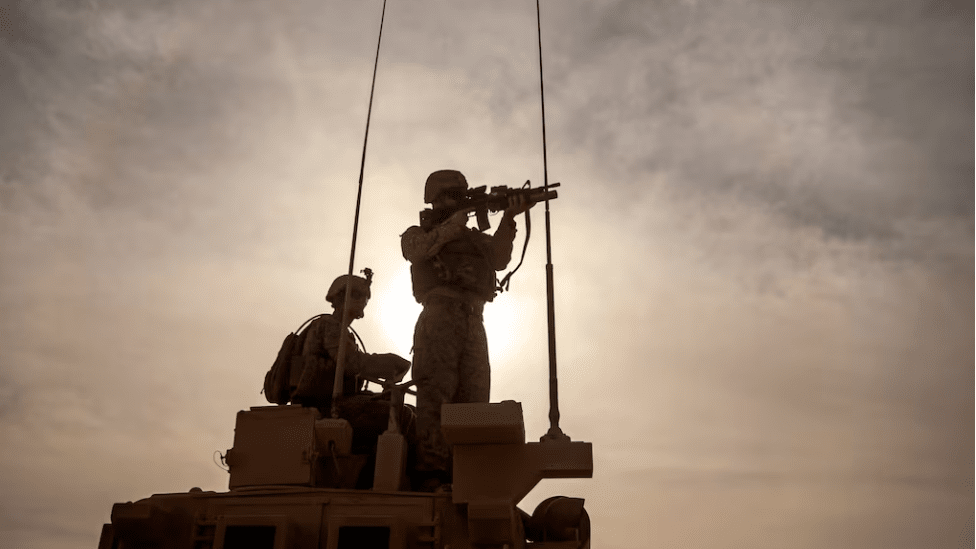
A senior U.S. Army general has acknowledged the growing vulnerability of American forces to Iran’s missile and drone capabilities, saying the military must overhaul its operational approach and relearn how to conceal and disperse its forces after decades of relying on large, secure bases.
As reported by IRAF, a recent report in U.S. military media suggests that Iran’s increasingly precise and long-range strikes on American military facilities in West Asia have forced the U.S. Army to reassess the way it operates.
Military Times reported that James P. Isenhower III, commander of the U.S. Army Combined Arms Center, told a Pentagon gathering that the Army must relearn “how to hide.”
“Being hidden in plain sight is becoming a necessity,” Isenhower said, referring to fundamental changes in the nature of modern warfare.
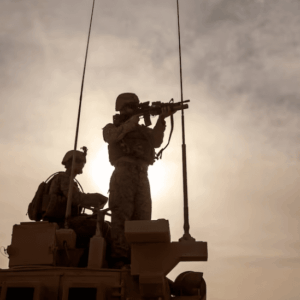
He said that two decades of military operations in Iraq and Afghanistan had left the U.S. Army detached from many of the skills associated with camouflage, dispersion and protection against long-range aerial threats — capabilities that were once central to military training during the Cold War.
Iran’s strikes drive shift in U.S. military strategy
The remarks come amid a series of Iranian missile and drone attacks on U.S. military facilities in Bahrain, Jordan and Kuwait in recent months. According to U.S. media reports, some of the attacks penetrated air-defense systems and caused significant damage and casualties.
On Feb. 28, Iran targeted the U.S. naval support facility in Bahrain with missiles and loitering munitions in response to attacks by the United States and Israel.
The Pentagon initially said the attack had not had a “significant impact” on U.S. operations. The Wall Street Journal later reported that the damage was estimated at around $400 million.
Hung Cao, the acting U.S. Navy secretary, also acknowledged in an interview with The Epoch Times that Iran had “hit Bahrain hard.”
In July, an Iranian missile and drone strike on Muwaffaq Salti Air Base in Jordan killed three U.S. service members, according to the report, after penetrating layers of air defense around the facility.
A separate Iranian drone strike in March hit a U.S. tactical operations center at Kuwait’s Shuaiba port, killing six American personnel.
The range and precision of the attacks, U.S. analysts said, marked a sharp departure from the rocket attacks faced by American forces during the wars in Iraq and Afghanistan and underscored the growing vulnerability of large military bases.
‘The base itself is now a vulnerability’
Kelly Grieco, a senior fellow at the Stimson Center, told Military Times that U.S. air superiority during the war on terrorism had allowed American bases to function as relatively secure sanctuaries — an arrangement she described as a historical exception.
“Now the base itself is a vulnerability — something the enemy can attack,” she said.
Grieco also warned that relying on costly interceptor missiles to counter Iranian ballistic missiles and inexpensive loitering drones was placing increasing pressure on U.S. air-defense stockpiles.
According to the Center for Strategic and International Studies, the United States used 65% of its Patriot missile stockpile between February and July, while its stockpile of THAAD interceptors declined by 38%.
Survival over efficiency
Military analysts say dispersing forces to reduce their vulnerability comes at a significant logistical cost.
After years of relying on large and centralized installations, the U.S. military is now being forced to distribute fuel, ammunition, food and equipment across a wider network of smaller and more distant locations.
“We’re trading efficiency for survivability,” Grieco said.
Following heavy damage in Bahrain, U.S. ships were forced to rely on Diego Garcia in the Indian Ocean for logistical support, according to the report. The island lies more than 3,200 km from U.S. aircraft carrier strike groups.
The distance has reportedly forced American personnel to place food orders up to 30 days in advance, creating additional challenges given the unpredictable nature of military operations.
A return to Cold War-era skills
Isenhower said the U.S. Army had spent the past 20 years largely unconcerned about threats “coming from the sky,” causing it to lose some of the skills developed during the Cold War.
He said training in electromagnetic warfare, drone operations and camouflage was now being incorporated at all levels of the Army, with troops required to learn how to operate in an environment in which they themselves could be detected and targeted.
The developments point to a significant shift in U.S. military thinking as Iran’s missile and drone capabilities challenge assumptions that shaped American operations during the conflicts in Iraq and Afghanistan.
Large bases, air superiority and expensive missile-defense systems can no longer be treated as guarantees of security, the emerging assessment suggests.
Washington is increasingly being pushed toward concealment, force dispersion, a reduced military footprint and the revival of Cold War-era operational skills — a shift that U.S. military officials increasingly describe not as a matter of choice, but as a necessity in response to Iran’s expanding capabilities.