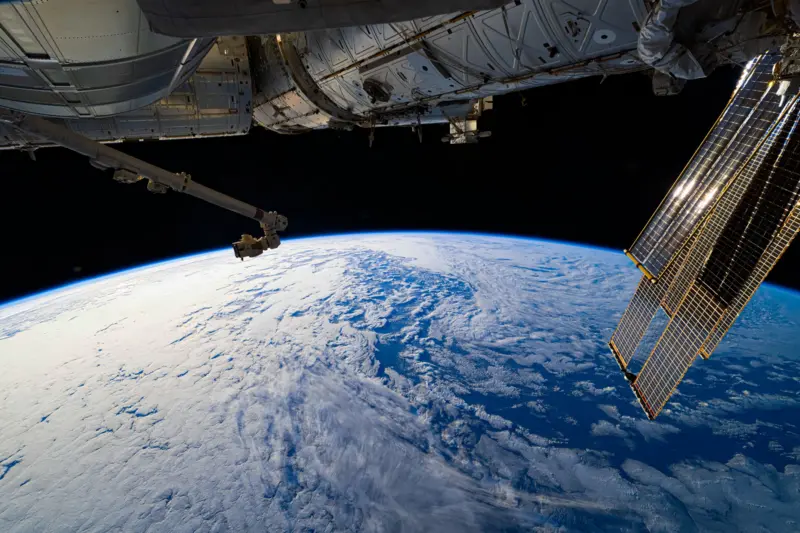
The United States has deployed an orbital weapon in space for the first time, according to the U.S. Department of the Air Force, in a move Washington says is aimed at countering growing threats from Russia and China and which analysts view as another sign of intensifying great-power competition in space.
As reported by IRAF, U.S. Secretary of the Air Force Troy Meink said at the Air, Space & Cyber Conference that the United States had activated a weapons system in Earth orbit to protect its interests against the “hostile actions of adversaries.”
Meink did not disclose technical details, the timing of the deployment or the weapon’s specific capabilities, saying only that the move was part of U.S. preparations for “evolving threats.”
US Steps Up Focus on Space Warfare
Senior U.S. military commanders have repeatedly stressed in recent months that Washington intends to strengthen its military capabilities in space.
They have pointed to Russian and Chinese efforts to develop systems capable of targeting U.S. satellites, warning that future conflicts could directly threaten space-based assets.
The administration of President Donald Trump has also previously said that “space-based capabilities” and interceptor missiles would form a central part of the defense architecture known as the Golden Dome, which is designed to counter missile and airborne threats.
Pituffik Base and the US Space Presence
An image taken on October 4, 2023, at Pituffik Space Base in northern Greenland shows a large satellite dish alongside operational containers. The facility, formerly known as Thule, is now considered one of the key sites supporting U.S. space activities.
The U.S. Space Force
The U.S. Space Force, the newest branch of the U.S. military, was established in 2019 to protect hundreds of American communications, surveillance and navigation satellites.
A Space Force spokesperson has said that “control of space” is pursued through missions that provide the ability to disrupt, degrade and, if necessary, destroy an adversary’s capabilities.
The spokesperson said these tools could be used in both offensive and defensive roles at the direction of combatant commanders.
Trump also issued an executive order last year emphasizing the “offensive” role of the Space Force in the broader U.S. defense strategy.
Space Race Moves From Surveillance to Potential Attacks
Reports in February said two Russian satellites had potentially intercepted communications from at least 12 European satellites since the start of the war in Ukraine, an activity that could have given Russian intelligence services access to sensitive data.
The United States also accused Russia in 2024 of launching a satellite “capable of attacking similar orbiting spacecraft.” Moscow has not formally responded to the accusation.
The U.S. Space Force says China has also developed and deployed “space and counterspace capabilities” as part of its military modernization strategy, while Russia views “space as a future battlefield” and considers space superiority a decisive factor in future conflicts.
The developments underscore how competition among major powers is moving beyond land and sea and increasingly into Earth’s orbit, where each new military capability could alter the global security balance.