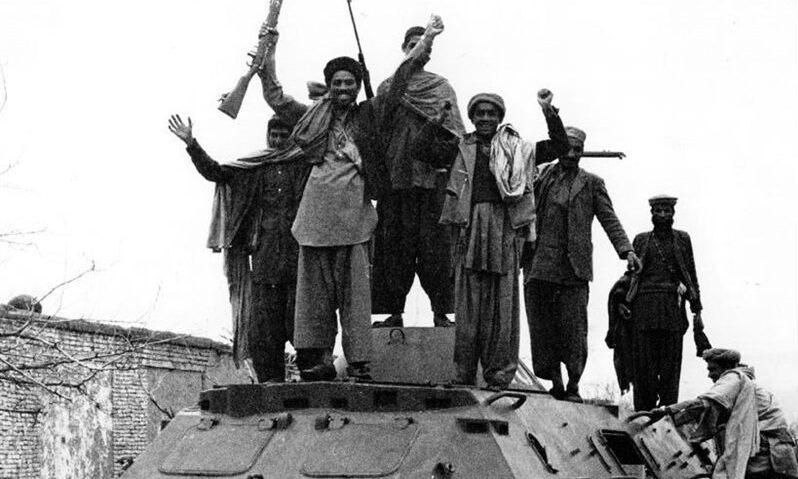
Tehran- IRAF- the third of Hoot 1980, is one of the bloodiest and most decisive days in modern Afghan history, a day when segments of Kabul’s population rose against the military presence of the Soviet Union and the rule of the People’s Democratic Party of Afghanistan (PDPA), facing unprecedented repression.
This day holds a special place in Afghanistan’s calendar and, despite the passing years, is still remembered as the day the people rose against communist colonialism.
Afghan Response to Communism
Historical accounts indicate that after Soviet forces entered Afghanistan on December 27, 1979 and Hafizullah Amin was killed, power was handed to the Parcham faction of the PDPA under Babrak Karmal.
The large-scale presence of Soviet troops in Kabul and the heavy security atmosphere sparked waves of anger, discontent, and protest among citizens, especially young people and students.
At dawn on the third of Hoot, protests began in several neighborhoods of Kabul. Historical reports show that these demonstrations started spontaneously and scattered, but quickly spread to the central streets.
What distinguishes the Third of Hoot uprising from other anti-colonial movements is its beginning: it started from the rooftops with cries of Allahu Akbar, a symbol of revolution and struggle against communism, and then escalated into street fighting.
On the night of the Third of Hoot, anti-occupation slogans, takbir chants, and protests against the ruling party were heard throughout the city. Some sources note the role of students, schoolchildren, and merchants in the initial organization of these movements.
The Last Bullets of Tyranny
Government security forces and Soviet soldiers deployed at intersections and key points of the city to confront the protesters with force.
According to eyewitness accounts, direct shooting at people, mass arrests, and efforts to instill fear in the public were among the measures implemented in the early hours.
Accurate statistics on the number of dead and wounded are not available, but various sources report dozens of deaths and a large number of arrests.
Although the Third of Hoot uprising was suppressed on the same day, it had significant political and social consequences. This event demonstrated that opposition to the Soviet presence and the ruling party’s policies was not limited to armed groups in the provinces, but that a socially active protest base also existed in the capital.
Many analysts consider the Third of Hoot a turning point in the expansion of urban resistance against the Soviet occupation—a resistance that later escalated into a full-scale, protracted war.
Today, decades after the event, the Third of Hoot remains a symbol in the historical memory of parts of Afghan society, representing the steadfastness of the people of Kabul against foreign occupation and ideological rule. A day when the voice of protest, although silenced by blood, became an integral part of the narrative of resistance in modern Afghan history.