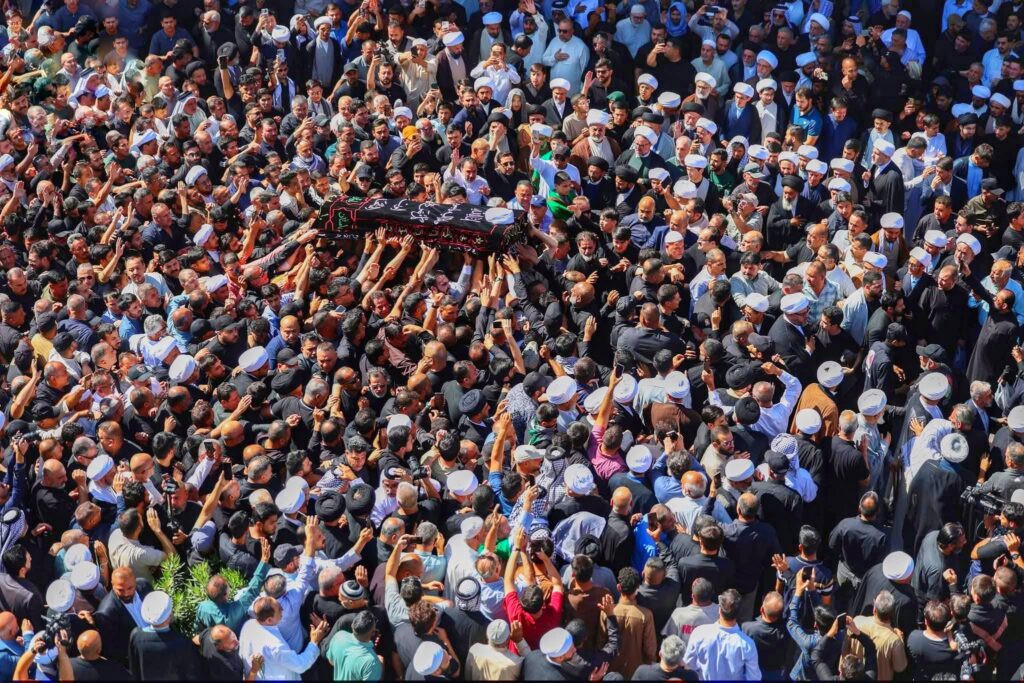
According to Iraf, in recent days various cities of Iraq were the scene of a rare farewell to this Shia religious jurist and scholar of Afghan origin — a farewell accompanied by the broad participation of diverse segments of the population, seminary students, clergy, and prominent political figures, including the Prime Minister of Iraq.
This massive turnout demonstrated that the scholarly and moral standing of Ayatollah Fayyad was defined beyond national and geographic attachments, and that his popularity was built upon knowledge, piety, and social conduct — not merely nationality or ethnic origin.
In the condolence messages issued by religious authorities and political figures, this very standing has been emphasized. In the condolence message of Grand Ayatollah Seyyed Ali Sistani, the supreme religious authority of Iraq’s Shia community, Ayatollah Fayyad was remembered as one of the prominent scholarly figures of the Najaf seminary who devoted his life to teaching, research, and the education of students of religious sciences. The United Nations also issued a message on the occasion of his passing. The condolence message of Masoud Pezeshkian, President of Iran, likewise emphasized the scholarly role and spiritual standing of this religious authority in the Shia world.
Iraq, which hosted this distinguished jurist for decades, demonstrated through its declaration of three days of national mourning that his standing extended far beyond that of a religious figure confined to the seminaries. The spiritual personality of this great religious authority transcended ethnic and political boundaries, bringing together diverse religious communities — including a portion of Iraq’s Sunnis — at the commemorative and funeral ceremonies. The presence of Sunnis alongside Shias at these ceremonies is a reflection of the moderate and unity-oriented approach that many of his students and close associates cite as one of the intellectual and behavioral hallmarks of Ayatollah Fayyad.
From Baghdad to Najaf, from Kadhimiya to Karbala, funeral and commemorative ceremonies were held with the broad participation of the public, clergy, seminary students, political figures, and senior Iraqi officials. The attendance of Iraq’s Prime Minister and other senior officials at these ceremonies was a reflection of the spiritual influence and social prestige of a religious authority who devoted his life to the service of knowledge, religion, and the education of successive generations of religious scholars.
What drew the most attention in the days following Ayatollah Fayyad’s passing was the vast number of people who took to the streets with profound grief to bid him farewell. Many of them were neither his direct students nor his followers, yet they regarded him as a symbol of piety, asceticism, moderation, and learning within the Najaf seminary. This widespread popularity, according to some observers, was the product of decades of scholarly and ethical conduct rooted in keeping aloof from political tensions and emphasizing religious coexistence in Iraqi society.
The life of Ayatollah Fayyad is inspiring in many respects. He was born in Afghanistan, spent his youth on the path of studying religious sciences, and then made his way to Najaf — a city that has for centuries been the center of Shia thought. Among hundreds of seminary students and religious scholars, through scholarly perseverance, jurisprudential depth, and the attainment of the highest levels of ijtihad, he rose to become one of the most distinguished and respected religious authorities of the Najaf seminary — a standing that, in the view of many seminary professors, can only be achieved through years of continuous scholarly effort, spiritual self-refinement, and mastery of the foundations of jurisprudence and its principles.
Perhaps the most important message of this historic funeral procession lies in the very fact that a seminary student who rose from Afghanistan was able to reach such a level of knowledge and spirituality that Iraq — with all its ethnic and religious diversity — mourned his passing. The draping of Iraq’s holy cities in black and the massive public presence at the various ceremonies was not merely a tribute to an individual, but a celebration of a school of thought rooted in knowledge, moderation, and coexistence.
Najaf has throughout history introduced great scholars to the Islamic world, but the magnificent farewell accorded to Grand Ayatollah Mohammad Ishaq Fayyad demonstrated that his standing among the people and religious elites was truly exceptional and unparalleled. This universal respect once again proved that geographic boundaries cannot confine the greatness of a religious scholar — when knowledge, piety, and sincerity converge, a migrant seminary student can become a religious authority whose passing moves millions to tears and causes a nation to declare days of public mourning.