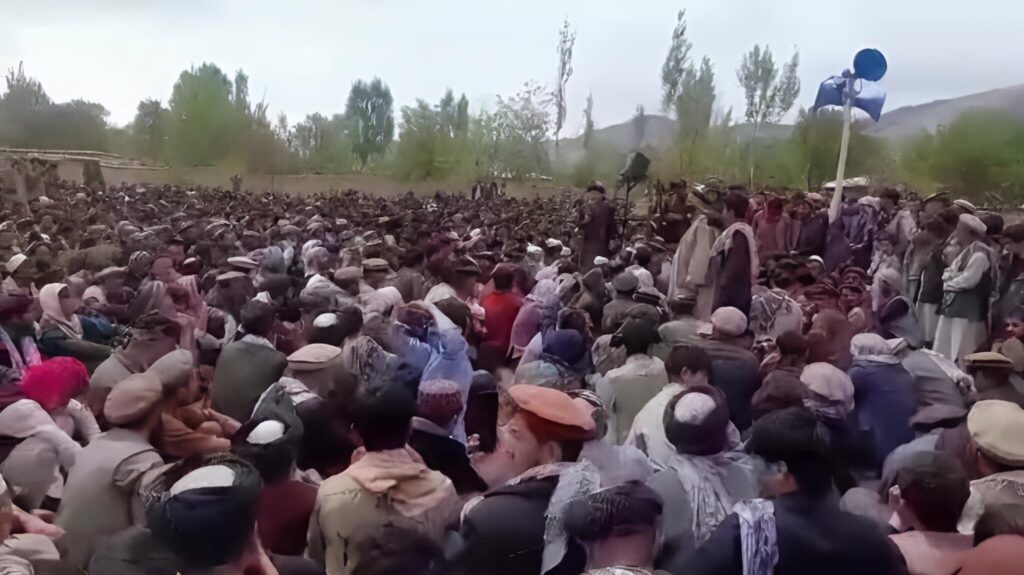
Recent developments in Afghanistan’s northeastern province of Badakhshan have moved beyond localized protests and evolved into a broader confrontation involving the Taliban, armed opposition groups, and mounting social unrest, according to Mohib Babak, a PhD candidate in sociology at the University of Tehran and an analyst of Afghan affairs.
In an interview with IRAF, Babak said the situation in Badakhshan can no longer be understood solely through the lens of local grievances, arguing that economic, ethnic, cultural, and political factors, combined with the Taliban’s security policies, have created conditions for a new wave of armed resistance and public dissatisfaction.
A New Phase in Badakhshan
Referring to the changing nature of unrest in the province, Babak said:
“The recent protests in Badakhshan have taken on a new form and can no longer be considered similar to the protests that took place over the past one or two years in districts such as Argo.”
He added:
“In the past, we mostly witnessed local protests and social demands, but today the situation has changed. The issue is no longer just protests; in parts of Badakhshan we are now witnessing open warfare between the Taliban and opposition movements.”
The Afghan affairs analyst continued:
“The Taliban’s opposition fronts in this region have openly declared their positions, issue statements, have their own flags, and pursue armed struggle against the Taliban. Therefore, this situation cannot simply be regarded as local discontent.”
Babak said:
“Popular and local protests are one part of the issue, but the larger part relates to military confrontation and the emergence of different fronts. In recent months, we have witnessed face-to-face fighting between the Taliban and opposition forces.”
Referring to recent developments on the ground, he said:
“In recent weeks, Yaftal district fell for a period of time; this happened without widespread fighting or bloodshed, and the opposition forces later returned to their positions. Fighting has also intensified in Zebak district, and these clashes are still continuing.”
According to Babak:
“These developments show that the issue in Badakhshan goes beyond limited social protests and should be examined within the framework of a broader security crisis.”
Economic and Identity-Based Drivers
Babak identified two key factors behind the current unrest.
“In my opinion, two very important factors play a role in the current developments in this province: the economic factor and the ethnic and identity factor.”
On the economic dimension, he said:
“Over recent years, Badakhshan has become one of Afghanistan’s important provinces in terms of mineral resources. Gold, lapis lazuli, emeralds, and other natural resources are found in this region, and extensive mining activities are underway.”
He continued:
“But the main problem is that in many cases mining has been carried out in a non-standard, illegal, and destructive manner. This has damaged agricultural land, orchards, and indigenous areas, increasing dissatisfaction among local residents.”
Babak added:
“Some people feel that their region’s natural resources have been handed over to other groups and individuals without local communities benefiting from them. This has become one of the main causes of the protests.”
Turning to identity issues, he said:
“Ethnic and identity issues in Afghanistan are deeply rooted, and unfortunately these sensitivities have increased during the Taliban period.”
He continued:
“In Badakhshan, language, culture, and religious diversity are highly significant. Through their particular perspective and narrative, the Taliban have intensified some identity-related concerns.”
Babak added:
“The province is home to Ismaili Shia Muslims and Twelver Shia Muslims, and unfortunately there have been reports in recent years of pressure and actions against these communities. Such issues can deepen social divisions.”
On language, he said:
“Badakhshan is one of the important regions of the Persian language and one of its historical birthplaces. Any disrespect toward the language and culture of the local people naturally increases feelings of dissatisfaction and alienation.”
Organized Opposition Groups
Discussing the Taliban’s armed opponents in Badakhshan, Babak said:
“When we speak of fronts, we mean movements that possess organizational structures, their own discourse, and clear programs.”
He added:
“At present, the Freedom Front, the National Resistance Front, Sepahiyan-e Mihan, and several smaller groups are active in Badakhshan. Some of these movements have not yet officially announced their identities, but their activities can be seen in different areas.”
He continued:
“These developments are not limited to one specific location. Over the past two months, armed clashes have been observed in areas such as Kashm, Zebak, and Yaftal.”
Asked about the possibility of a new anti-Taliban front emerging, Babak said:
“In my opinion, under the current circumstances there is no particular need to establish a new front. More important is the possibility of closer coordination among the existing fronts.”
He added:
“Growing public dissatisfaction and the accumulation of problems could encourage these movements to cooperate more closely and place greater pressure on the Taliban.”
Growing Internal Divisions
Commenting on the Taliban’s internal situation in Badakhshan, Babak said:
“The Taliban’s response to protests in recent years has mainly been security-oriented and accompanied by repression. Their response to armed resistance has been even harsher.”
He continued:
“But this very approach has created divisions within the Taliban’s structure in Badakhshan.”
Explaining further, he said:
“Differences have emerged between local Taliban members in Badakhshan and those brought in from outside the province to manage affairs. Many key positions, including governor, police chief, intelligence chief, and head of the mining department, are held by non-local personnel.”
He added:
“This has caused dissatisfaction among some local Taliban members as well, and even critical messages have been issued by some commanders.”
Strategic Importance
Highlighting the province’s strategic significance, Babak said:
“This province is of special importance not only for the Taliban but for Afghanistan as a whole. Badakhshan shares borders with China, Pakistan, and Tajikistan, and its geographical position is extremely sensitive.”
He added:
“Badakhshan’s mountainous and complex terrain has made it difficult for any government to fully control the region.”
Babak continued:
“Despite maintaining a large military presence, the Taliban cannot easily control all the mountainous areas or completely eliminate opposition forces.”
A Potential Turning Point
Babak concluded by warning that the province could become the starting point for broader developments across Afghanistan.
“Recent attacks on government centers, fighting in different districts, and attempts to move closer to the provincial capital show that Badakhshan has become a serious challenge for the Taliban.”
He added:
“If links between the active fronts in Badakhshan and opposition forces in areas such as Takhar, Kunduz, Baghlan, and Panjshir become stronger, pressure on the Taliban will increase.”
Babak concluded:
“Under the current circumstances, Afghanistan may be on the verge of a new transformation, and developments in Badakhshan could be one of the signs marking the beginning of these changes.”
Badakhshan, located in northeastern Afghanistan, has long been regarded as one of the country’s most strategic provinces because of its borders with China, Pakistan, and Tajikistan, its mineral wealth, and its history of local resistance. Its mountainous terrain has traditionally made it difficult for successive governments to establish full control. Since the Taliban returned to power in 2021, political restrictions, administrative changes, and growing social tensions have contributed to renewed unrest in parts of the province.