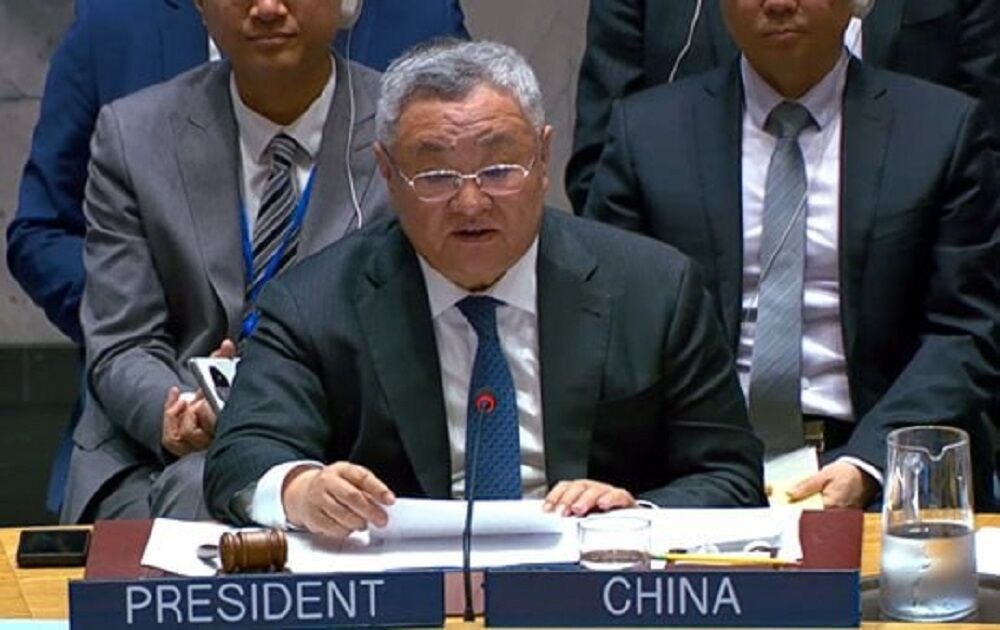
According to Iraf, Fu Cong, China’s Ambassador to the United Nations and the rotating President of the UN Security Council, explicitly criticized the draft resolution proposed by the United States and Bahrain regarding the Strait of Hormuz, stating that the text is “inappropriate in terms of content and timing” and that its adoption under the current circumstances would not help resolve the crisis.
He emphasized that Beijing does not consider the draft acceptable either in terms of content or timing.
He said, “We believe the content and timing are not suitable; therefore, adopting it at this stage would not be useful.”
The rotating President of the Security Council also added that if the decision were up to China, the resolution would not even have been placed on the Council’s voting agenda.
The Controversial Draft by the U.S. and Bahrain
On May 5, 2026, U.S. Secretary of State Marco Rubio announced that Washington, together with Bahrain and several Gulf Arab states—including Saudi Arabia, the United Arab Emirates, Kuwait, and Qatar—had submitted a draft resolution to the Security Council regarding the Strait of Hormuz.
In repeated allegations, the draft accused Iran of holding the global economy hostage through threats to ships, laying mines, and attempting to impose fees.
The draft calls on Iran to halt attacks, mine-laying, and maritime tolls, and to disclose the locations of naval mines.
The text contains 20 clauses, including 9 preambular clauses and 11 operative clauses, all drafted under Chapter VII of the UN Charter, which authorizes the Security Council to take binding and even military measures.
China and Russia’s Previous Vetoes
Previously, a similar anti-Iranian draft resolution by Bahrain on the Strait of Hormuz, submitted on behalf of the Gulf Cooperation Council (excluding Oman) and Jordan following U.S. and Israeli aggression against Iran, was vetoed by China and Russia at the April 7, 2026 session.
According to Security Council procedures, adopting any resolution requires 9 affirmative votes and no veto from the five permanent members, a condition that, given the explicit opposition from Beijing and Moscow, makes approval practically impossible.
U.S. Attempts to Legitimize Military Actions
After directly entering a war against the Islamic Republic of Iran, the United States now seeks to use the Security Council to legitimize its naval blockade and military actions in the Persian Gulf. According to diplomats and observers, this move could create a “dangerous legal precedent” in the international system.
The War Initiated by Washington
The current developments in the Strait of Hormuz are not merely a limited security dispute or maritime crisis, but a direct consequence of the war launched by the U.S. and Israel against the Islamic Republic of Iran on February 28, 2026. The Trump administration had assumed that a combination of military attacks, naval blockade, psychological warfare, and political pressure could control the situation, but the strategy has now evolved into a complex and costly crisis for Washington.