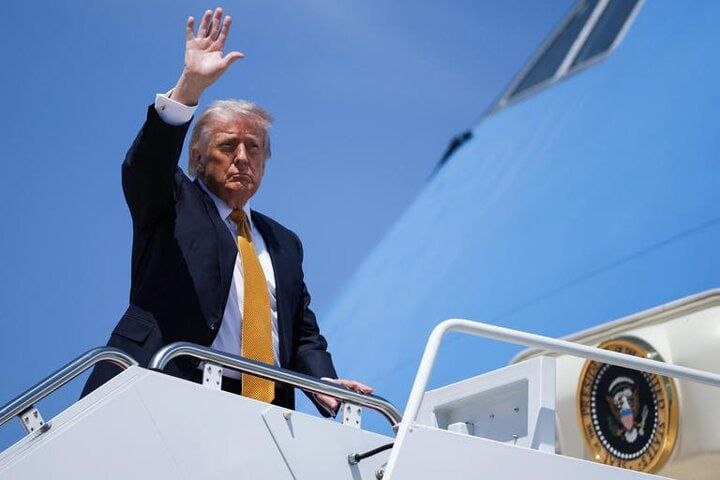
According to Iraf, Donald Trump arrived in Beijing today (Wednesday, May 13) for a two-day visit amid a global atmosphere shaped by escalating concerns over conflict, trade tensions, and technological rivalry.
He is expected to begin formal talks with Xi Jinping following a brief reception ceremony at the airport.
Before leaving the White House, Trump attempted to project strength, stating that the United States is “the world’s strongest military power” and that China ranks second.
Domestic Pressure on the U.S. Administration
The visit comes at a time when Trump’s popularity inside the United States has fallen to its lowest level in his second term, due to the war involving the United States and Israel against Iran and the resulting inflationary pressures.
U.S. courts have also overturned parts of his tariff regime, and what was expected to be a six-week war has turned into a prolonged and costly crisis, contributing to rising energy prices.
Unprecedented Economic Delegation Accompanying Trump
Trade is at the center of the talks, and Trump has brought a large group of senior executives from major U.S. companies, including Tim Cook (Apple), Elon Musk (SpaceX and Tesla), Jensen Huang (Nvidia), Kelly Ortberg (Boeing), David Solomon (Goldman Sachs), and Michael Miebach (Mastercard).
He is also accompanied by Secretary of State Marco Rubio and Defense Secretary Pete Hegseth, while the Treasury Secretary is expected to join after meetings in South Korea.
Low Expectations for Breakthroughs
One possible topic of discussion is the extension of last autumn’s trade truce, but analysts say there is little expectation for major breakthroughs.
Both leaders face internal constraints: Trump is dealing with political and economic pressure, while Xi Jinping is facing structural issues in China’s economy, including youth unemployment, a real estate slowdown, and energy concerns linked to the war against Iran.
Iran: A Topic Trump Downplays
Despite Trump’s claim that Iran is “not a priority in the talks,” the war against Iran continues to cast a shadow over U.S. politics.
The blockade of Iranian ports by the United States and Israel, restrictions in the Strait of Hormuz for hostile parties, disruption of oil shipping routes, and rising energy prices have all increased pressure on the U.S. administration.
China—one of Iran’s main trading partners—considers U.S. sanctions against Chinese companies illegal and has repeatedly called for an end to the conflict.
A senior U.S. official said Trump intends to pressure Xi Jinping regarding “revenues and goods China provides to Iran” and “possible arms exports.” However, China continues to emphasize a diplomatic solution and rejects unilateral U.S. sanctions as lacking international legitimacy.
Agenda and Objectives of the Visit
Trump is scheduled to attend an official reception on Thursday morning (May 14), visit the historic Temple of Heaven, attend a formal banquet in the evening, and hold working meetings and a tea-and-lunch session with Xi Jinping on Friday. Another meeting between the two leaders is expected later this year in Washington.
The U.S. administration hopes to initiate a “joint trade committee” with China to prevent a repeat of last year’s trade war, which began after Trump raised tariffs and China responded by restricting exports of rare earth materials.