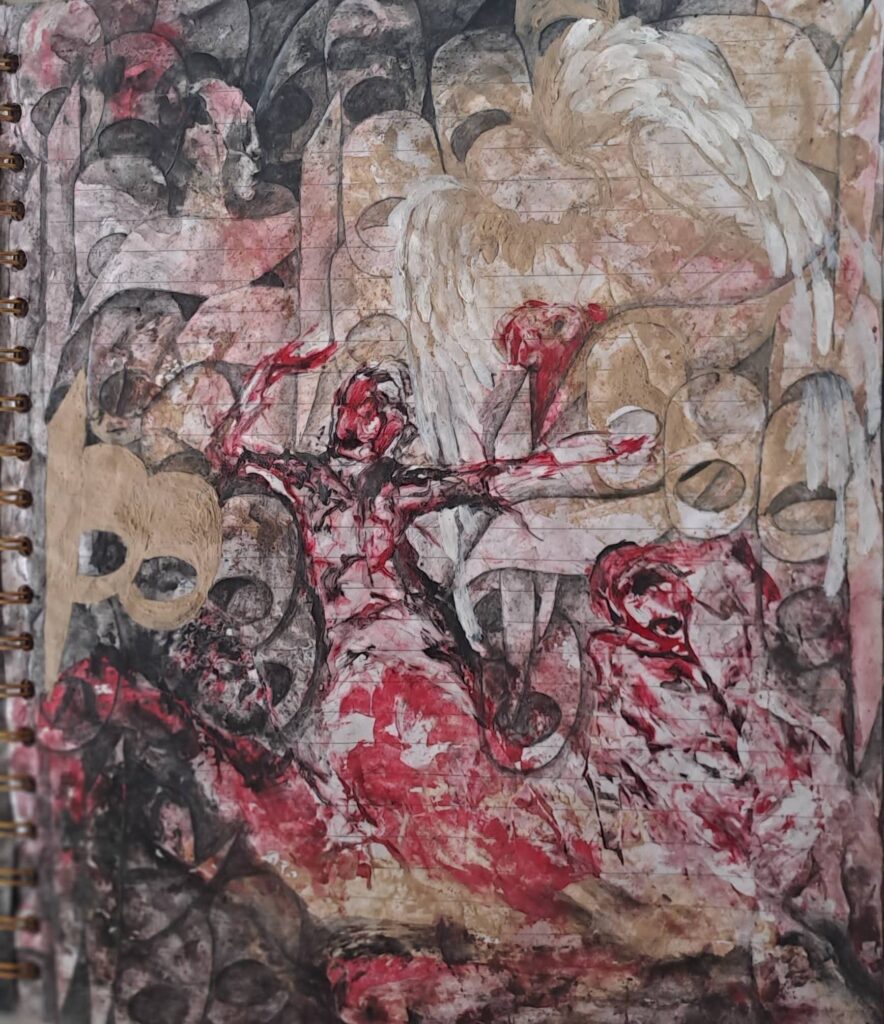
According to Iraf, and quoting Rah-e Abrisham, the “Aah Collection” is an artistic narration of one of the most catastrophic massacres in the contemporary history of Afghanistan. The collection includes paintings of the mutilated bodies of girls killed in the explosion at the Sayed al-Shuhada School.
This collection is the work of Ayatollah Ahmadi, a former professor at the Faculty of Fine Arts at Balkh University, who migrated to Germany after the fall of the country.
Ahmadi has produced several collections so far. The digital version of another of his works, titled “Qors-e Jan,” was sent into space on February 26, 2025, by the SpaceX company.
Ayatollah Ahmadi created the “Aah Collection” using his own blood on the notebooks of the killed girls.
The Naming of the “Aah” Collection
Some time after the bloody suicide attack on the Sayed al-Shuhada School in western Kabul, Ahmadi visited several families of the victims. He carried a notebook and pen with him to record, through visual art, feelings, pain, and words that cannot be expressed in writing.
On one of those days, Ahmadi met an elderly mother whose young daughter had been killed in the attack. The mother used to go every day to the school gate and wait for her daughter to return from class. Ahmadi walked with her from the school to her home. He says that along the way, the mother kept sighing in remembrance of her daughter.
When they reached home, the mother showed Ahmadi her daughter’s belongings. Very little had remained—only some clothes and a worn-out notebook in which the girl had written everything: her field of study, her daily study schedule, parts of her lessons, and even small, achievable hopes.
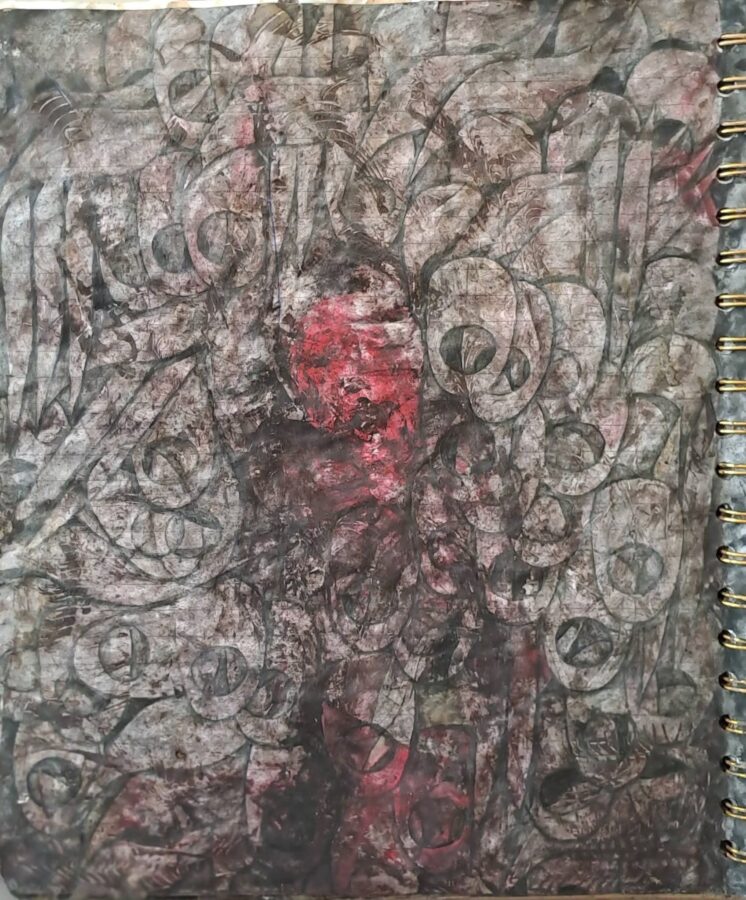
Ahmadi bought that notebook from the mother, explaining that it could become inspiration for a major artistic work. He told her that he would create important works in memory of her daughter. The mother understood the significance of his words and sold him the notebook. But when one of the last remaining mementos of her daughter was taken from her home, the grieving mother involuntarily sighed. From that moment, Ahmadi named the collection “Aah,” in memory of that mother and daughter.
The Story of the “Aah Collection”
The “Aah Collection” is not an imaginary or purely fictional narrative; it is rooted in real events. The entire collection is based on the suicide attack on the Sayed al-Shuhada School in western Kabul. On 18 of the month of Saur 1400 (April 2021), on a spring afternoon during the dismissal time of Hazara schoolgirls, suicide attackers targeted them. In that attack, later claimed by ISIS, more than 300 young girls were killed or injured.
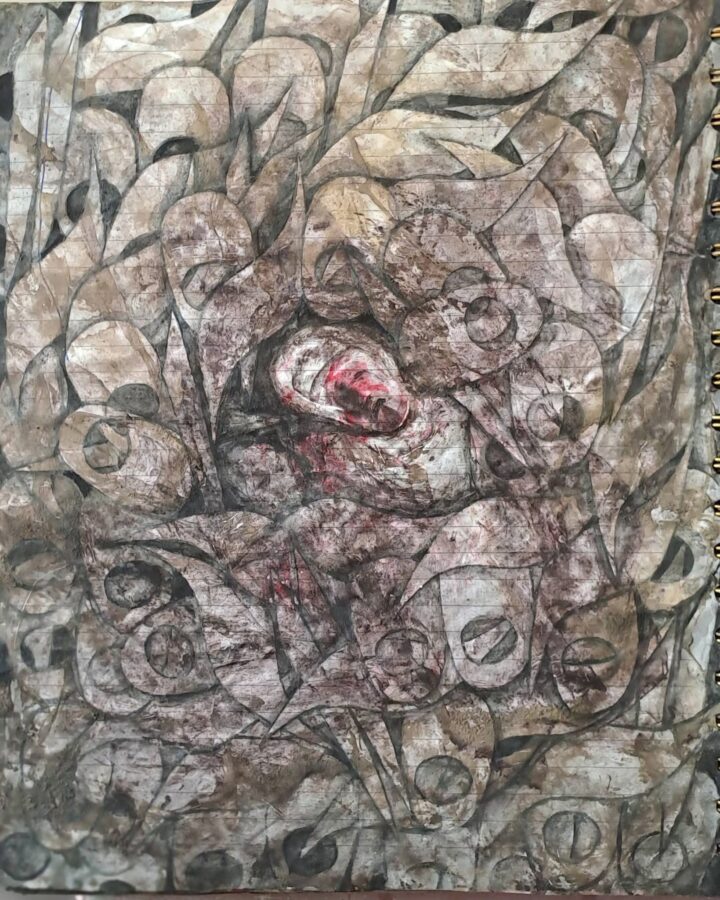
But the tragedy was not only the killing of the girls; it also included the suffering of their families, especially their mothers. After the incident, many of those mothers shared a common fate of grief, each carrying a unique personal story. Ahmadi, in an interview with the “Jadeh-ye Abrisham” weekly, recalls an elderly mother who would sometimes spend days sitting in her daughter’s classroom chair, staring at the classroom door and the school gate for hours, waiting for her daughter to emerge—never accepting that her child would not return home.

“Materials of Work: Soil and Memories”
One of the distinctive features of the “Aah Collection” is its material composition. The works are created from soil and memories. Ahmadi says he personally collected the materials, part of which consists of soil taken from the graves of the girls killed in the attack.
In terms of content, the collection is also drawn from the memories of those girls.
After the incident, Ahmadi repeatedly visited the families of the victims, spoke with parents, listened to their stories, and tried to capture their emotions. He also studied written testimonies and memoirs of survivors, including works published by Hassan Adib in the newspaper Etilaat-e Roz.
Visual History
Most of the paintings in this collection depict half-burned, blood-soaked bodies. Corpses with open mouths and unrecognizable faces lie among crowds and on old notebooks that clearly reflect the identity and background of the victims.
Some pieces are calligraphic paintings that depict not only the massacre itself but also the grief of the days after the tragedy. Behind the bodies lie faint, fading “layers of sighs” that gradually disappear, unheard by anyone.
From a viewer’s perspective, some of these works evoke scenes from Victor Hugo’s Les Misérables, where suffering is described as invisible, silent, and unacknowledged—like smoke that burns but leaves no trace.
The accumulation and fading of these “sighs” behind the bodies in the collection reflect the depth of the survivors’ grief. They were left in silence, without justice or voice, returning only days later to poverty and continued suffering.
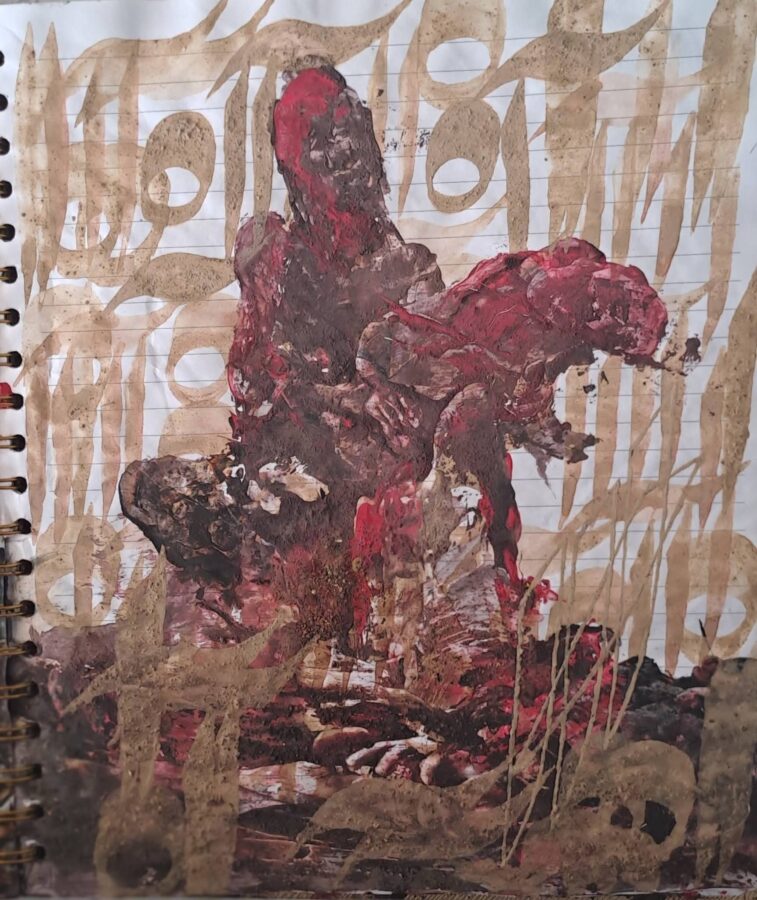
Geographically as well, the “sighs behind the bodies” accurately reflect the real environment of the incident: many of the victims’ families lived just behind the Sayed al-Shuhada School. The elderly mother who returned daily to the school gate lived only a few steps above the school, constantly confronted with the empty classroom and the memory of her daughter’s burned body.