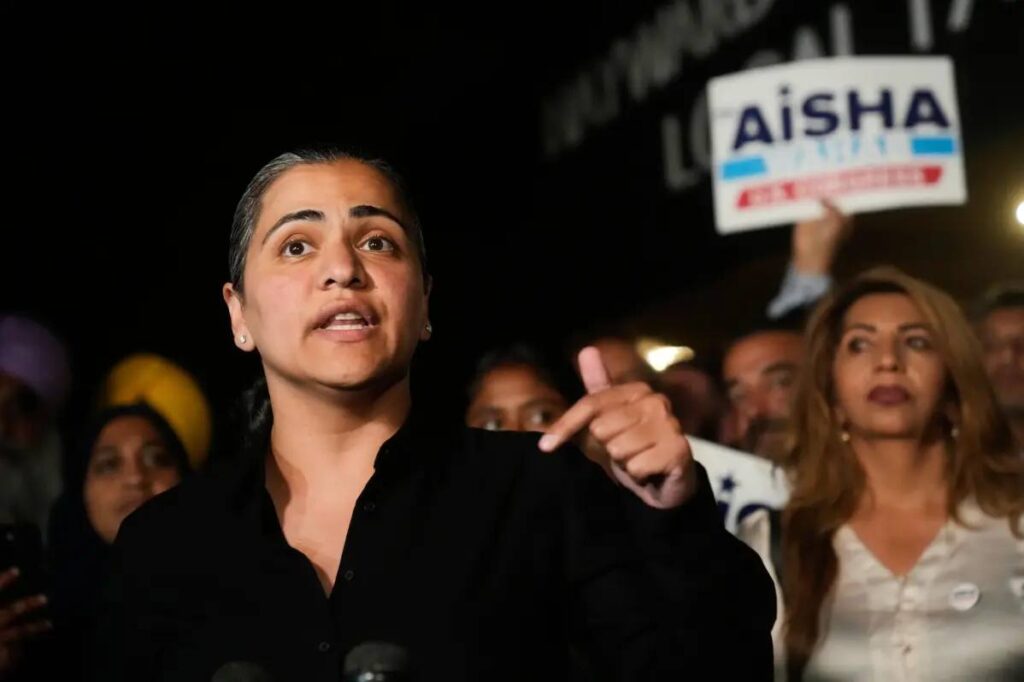
Aisha Wahab, the first Afghan-American Muslim woman elected to the U.S. House of Representatives, has called for Washington to maintain diplomatic relations with Afghanistan regardless of which group is in power, saying direct and formal engagement with the Taliban could encourage the group to improve its human rights record and change its policies toward women.
Wahab has also described Taliban opponents as “deeply failed and misguided,” arguing that some opposition groups had previously contributed to instability and disorder in Afghanistan with U.S. backing.
Her remarks have triggered a broad backlash from Afghan political activists, writers and women’s rights advocates, with critics accusing her of overlooking the restrictions imposed on Afghan women under Taliban rule.
Wahab made the comments only days after her election victory, which drew widespread support from Afghans on social media. Her position on engagement with the Taliban has since prompted some former supporters to turn against her.
Hamira Qadery Criticizes Wahab’s Position
Afghan writer and women’s rights activist Hamira Qadery sharply criticized Wahab’s comments, urging her to imagine the conditions faced by women living under Taliban rule and to spend a day under those circumstances.
Qadery pointed to restrictions on women’s access to education, employment, freedom of movement and social freedoms, arguing that support for engagement with the Taliban without taking those conditions into account was open to criticism.
Davood Erfan Questions Who Wahab Considers Taliban Opponents
Political activist Davood Erfan also questioned Wahab’s characterization of Taliban opponents.
He asked whether the millions of Afghans deprived of basic rights should be considered “misguided” if they are included among the Taliban’s opponents, and whether, under Wahab’s view, only Taliban supporters could be considered successful or justified.
Erfan said such an approach could help justify Taliban policies and accused Wahab of attempting to lobby in favor of the group.
Former Afghan diplomat Mohammad Ashraf Haidari, however, took a different approach, saying a distinction should be made between Wahab herself and the substance of her remarks.
Haidari argued that leaving Afghanistan indefinitely under what he described as the Taliban’s “repressive, exclusionary and gender-apartheid” system would have negative consequences for Afghans as well as regional and global security.
At the same time, he said principled U.S. diplomatic engagement with the Taliban would not necessarily amount to recognizing the group or surrendering to it. Instead, he said, engagement could be used to pressure the Taliban and pursue changes in inclusive governance, human rights, women’s participation and lasting peace.
Haidari also said Afghanistan needed an inclusive, national and legitimate political alternative, arguing that a return to armed factions and figures who had played a role in the country’s destruction in the past could not provide an adequate solution for its future.
He added that having an Afghan-origin politician in U.S. politics was not, by itself, an achievement for Afghanistan, and called on Afghans to replace emotional reactions with organized efforts and clear positions when engaging with such politicians.
Critics Link Wahab’s Position to Ethnic Politics
Political activist Hassan Ali Edalat compared Wahab’s remarks with the policies of former U.S. special representative for Afghanistan Zalmay Khalilzad.
Edalat alleged that Wahab’s support for relations with the Taliban was rooted in an ethnic and tribal outlook. He said the positive response from some Pashtun Afghans to her remarks had created concerns among other ethnic groups, including Tajiks, Hazaras and Uzbeks.
Edalat also described Afghanistan’s conflict as being closely linked to what he called “ethnic exclusion and denial,” portraying Wahab as a symbol of an ethnic and tribal political outlook.
Faheem Sediqi, meanwhile, defended Wahab against some of the criticism, saying many of her opponents had “got the wrong address.”
Sediqi said Wahab was an American politician and that it was natural for her to take U.S. interests into account. He added that Washington already engages with the Taliban and argued that the central question was why such engagement should not be formal, transparent and conditional.
Ali Meisam Nazary Accuses Wahab of Helping Normalize Taliban
Ali Meisam Nazary, head of foreign relations for Afghanistan’s National Resistance Front, strongly criticized Wahab’s position, saying her remarks effectively amounted to support for normalizing relations with the Taliban.
Nazary also alleged that Wahab’s background and political environment had influenced her current views. He accused her of using her Afghan identity to build her political profile in the United States while distancing herself from the demands of women and opponents of the Taliban.
He called on Afghans opposed to normalizing relations with the Taliban to use civil and legal means, including media campaigns, public gatherings and peaceful protests, to hold Wahab accountable.
Farzana Nabavi Urges Afghans Not to Overreact
Women’s rights activist Farzana Nabavi took a more measured position, saying Afghans should not be overly concerned about Wahab’s remarks because she is new to U.S. politics and American foreign policy is far more complex than the position of a single member of Congress.
Nabavi said Afghanistan’s future depended less on decisions made overseas than on the determination and persistence of Afghans themselves to pursue their demands.
She added that if Afghans remained committed to what they considered legitimate demands, no foreign power could permanently stand against their will.
Asif Akbari, meanwhile, reposted Wahab’s remarks emphasizing her call for formal U.S. diplomatic relations with the Taliban. He also recalled that former Afghan Vice President Amrullah Saleh had previously urged Wahab, around the time of her election victory, to remain “that American,” saying Afghanistan had “unpleasant memories” of people with dual passports.
Rukhsana Alizada also criticized Wahab, saying the Afghan-origin politician had accused Taliban opponents of pursuing personal interests rather than Afghanistan’s interests.
The Taliban had not commented on Wahab’s remarks by the time of publication.
The reaction to Wahab’s comments highlights a broader divide over how Washington should deal with the Taliban. Some critics view any form of engagement or recognition as a step toward normalizing the group, while others argue that the key issue is the terms and conditions under which such engagement takes place.
Since the Taliban returned to power, many countries have withheld formal recognition of the group’s government. International organizations and some governments have also made the protection of women’s rights and the reopening of schools for girls among the conditions they have cited for deeper relations with the Taliban.