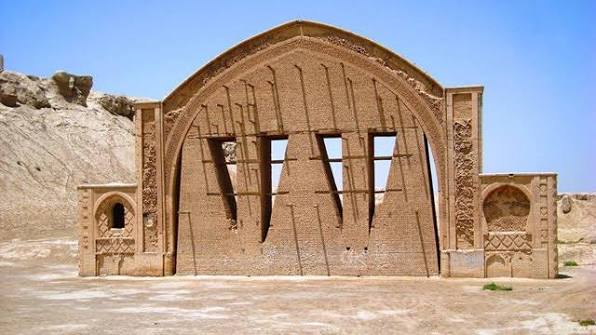
The restoration of the ancient Bost Citadel in Afghanistan’s southern Helmand province is about 70% complete, Taliban authorities say, as work continues on one of the country’s most significant historical landmarks.
The centuries-old fortress, located near Lashkargah at the junction of the Helmand and Arghandab rivers, was once part of the ancient city of Bost — a major political, military and commercial center that linked different parts of the historical region of Khorasan.
According to Afghanistan’s Ministry of Information and Culture under the Taliban administration, the restoration project aims to preserve the remaining structures of the citadel, including its defensive walls, towers and other architectural features.
A strategic city on ancient trade routes
Historical records describe Bost as one of the most important cities in southern Afghanistan. Its location along trade routes connecting Khorasan with present-day Iran, India and China made it a strategic crossroads for merchants, travelers and armies.
The city’s proximity to the Helmand and Arghandab rivers also supported agriculture, settlement and commerce, contributing to its long-standing regional importance.
Because of its strategic position, Bost was repeatedly contested throughout history and suffered multiple waves of destruction.
A legacy linked to the Ghaznavid era
Bost reached particular prominence during the Ghaznavid dynasty, when it became one of the key cities of the empire. Historical accounts identify the city as one of the favored centers of Sultan Mahmud of Ghazni.
Among the most recognizable surviving monuments from that period is the celebrated Bost arch, whose distinctive design has become a symbol of the region’s medieval architectural heritage.
The remaining ruins suggest that Bost was more than a military fortress. Archaeological remains indicate the existence of a developed urban center with residential, administrative and defensive structures that evolved over centuries.
Preserving Afghanistan’s cultural heritage
The Bost complex is notable for its mud-brick and baked-brick architecture, reflecting construction techniques adapted to the climate of southern Khorasan. Its architectural features and defensive design have made the site valuable not only for visitors but also for historians and archaeologists studying the region’s urban past.
The restoration has renewed attention to the site’s potential as a cultural tourism destination. Situated against the natural landscape of the Helmand and Arghandab rivers, the historic complex offers a combination of archaeological, architectural and scenic significance.
Experts say that preserving sites such as Bost requires more than rebuilding damaged structures. Long-term protection depends on scientifically guided conservation, careful preservation of original materials and architecture, and the development of visitor infrastructure, including historical interpretation and multilingual information.
The restoration of Bost is also seen as an opportunity to highlight Afghanistan’s broader historical legacy. Beyond safeguarding an important monument, the project could help promote cultural tourism and create economic opportunities for local communities through heritage-related businesses and services.
Once fully restored and properly protected, Bost could emerge as one of southern Afghanistan’s most important historical tourism destinations, showcasing the region’s rich architectural and cultural heritage.