By Maryam Motamedi
Afghanistan, as a completely landlocked country at the heart of Asia, has no maritime borders or direct access to the open seas. As a result, the country is dependent on passing through the territory of its neighbors for international trade and transit. This geographic position has left Afghanistan highly vulnerable to the economic and political risks associated with dependence on foreign transit routes. From a geopolitical perspective, landlocked countries generally face higher transit costs, longer transportation times and strategic dependence on neighboring states, all of which pose serious challenges to economic growth and industrial development.
For decades, Afghanistan has relied on two main corridors to access international waters and global markets:
1. The southern route through Pakistan: via the Peshawar–Kabul and Chaman–Kandahar highways to the port of Karachi.
2. The western route through Iran: via the Herat–Dogharoun road, the port of Chabahar and the port of Bandar Abbas.
This dependence has repeatedly been used by Pakistan as a political lever over the past decades. Recurring tensions between Kabul and Islamabad, border closures—including at the Torkham crossing—and transit restrictions have imposed heavy costs on an economy dependent on imports and exports. According to data from Afghanistan’s Chamber of Commerce, trade between Afghanistan and Pakistan fell by 53 percent in 2025 alone, affecting a significant part of the economy and underscoring the need for alternative routes.
Beyond the visible costs of transit, the hidden costs of Afghanistan’s landlocked status include dependence on neighboring countries’ infrastructure and vulnerability to regional crises. Any unrest, border closure or change in trade policy in neighboring states can directly disrupt Afghanistan’s supply chains.
The Wakhan Corridor: A Way Out of a Geopolitical and Historical Deadlock
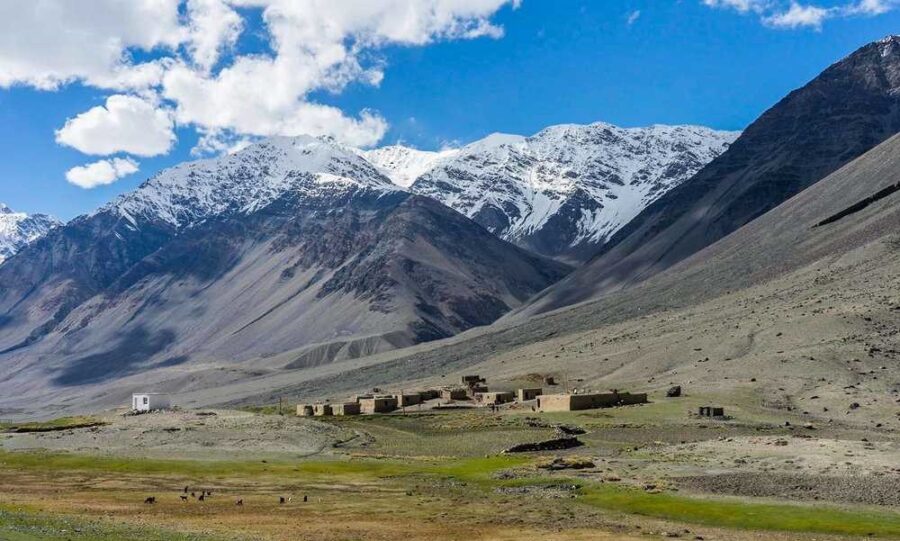
One possible way out of this geopolitical and historical deadlock is the Wakhan Corridor, a mountainous valley that connects three regions of the world—Central Asia, South Asia and East Asia. The Wakhan Corridor is located in Badakhshan province, about 600 kilometers east of the city of Mazar-e-Sharif. This narrow strip of land stretches for around 350 kilometers and lies at the intersection of three of the world’s major mountain ranges: the Hindu Kush, Karakoram and Pamir. In terms of its borders, the corridor is adjacent to Pakistan, China and Tajikistan.
Wakhan is a remote mountainous region with pristine landscapes and small, scattered settlements. Its inhabitants have lived in the area for more than 2,500 years and are followers of Ismaili Shiism.
For centuries, the Wakhan Corridor was regarded as one of the vital passages for Silk Road traders. This historic route, which emerged in the early centuries before Christ, linked the Chinese city of Xi’an with the shores of the Mediterranean. Large trading caravans moved along this route, exchanging valuable goods including Chinese silk, Persian silver, Roman gold and lapis lazuli extracted from the mines of Badakhshan.
China, which is keen to integrate Afghanistan into its Belt and Road Initiative (BRI), views the Wakhan Corridor as a means of expanding its economic influence in the region and beyond. The corridor could facilitate direct trade routes by bypassing more costly routes through Pakistan or Uzbekistan, thereby strengthening China’s economic foothold in Afghanistan. Unlike traditional routes that pass through one or two neighboring countries, the Wakhan Corridor would connect Afghanistan directly and without an intermediary to China, the world’s second-largest economy.
The corridor’s most important strategic advantages for Afghanistan’s economy include:
1. Creating an independent trade route that is insulated from political pressure or closures of southern borders.
2. Providing direct access to the Chinese market for Afghan exports.
3. Reducing transit costs and increasing the competitiveness of Afghan goods in global markets.
4. Turning Afghanistan into a crossroads connecting Central Asia with China, potentially strengthening the country’s position in the region’s economic architecture.
Another potential advantage of such a commitment would be improved connectivity between China and the Middle East, with less time required to transport goods between the two endpoints. Iran, for example, lies on the other side of Afghanistan from China and has port facilities with direct maritime links to the Indian Ocean.
Meanwhile, since the United States withdrew from Afghanistan in August 2021, Beijing has consolidated its position as Afghanistan’s main trading and investment partner, with bilateral trade reaching around $2 billion in 2024. Chinese companies have also signed contracts to develop Afghanistan’s oil, copper, lithium and gold reserves.
According to official statements by the Taliban government, 70 percent of the infrastructure for the Wakhan Corridor, which is 120 kilometers long, has been completed, with the route expected to become operational by late 2026.
However, China’s most important security concern surrounding the implementation of this economic project remains the potential radicalization of Uyghur Muslims in the western part of the country, an issue linked to the Wakhan Corridor. This has made China reluctant to open its border with Afghanistan—even for trade and transit—until Afghanistan achieves full stability. As a result, security risks have so far prevented Afghanistan from being fully integrated into China’s global Belt and Road Initiative.
Nevertheless, Wakhan is a reminder that Afghanistan occupies an exceptional geographic position and holds considerable strategic importance for global and regional powers.
At the same time, the unresolved tensions with its southern neighbor are increasingly encouraging the Taliban government to seek, in the long term, to minimize its reliance on Pakistan for imports and exports and promote alternative routes for foreign trading partners, including China and other Central Asian countries. As a result, the Taliban government may intensify its efforts to develop the Wakhan Corridor and present it as a viable solution to problems arising from Pakistan’s restrictive transit policies.
It is worth noting that following the border clashes on October 12, 2025, more than 10 months have now passed since all major trade routes between Afghanistan and Pakistan, including Torkham and Spin Boldak, were closed.
Overall, the Wakhan Corridor could mark a turning point in Afghanistan’s economic history, provided that security, investment and regional cooperation are achieved simultaneously. Otherwise, this road being built on the roof of the world could become a “highway to nowhere”—a dream at an altitude of 4,900 meters that never reaches the ground.