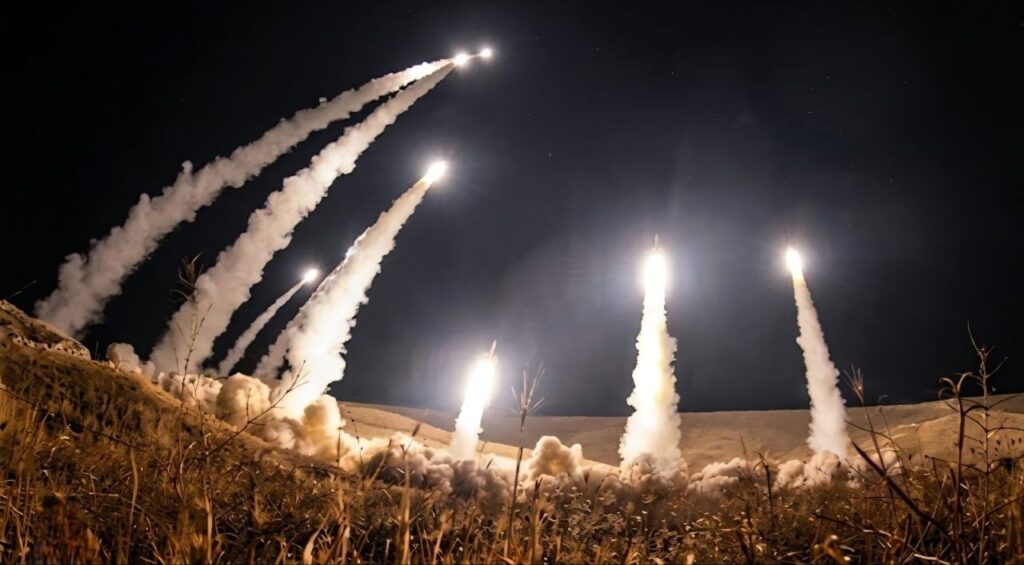
Iran and U.S. forces exchanged missile and air strikes early on Thursday after a fragile diplomatic lull collapsed, with Washington launching attacks on military targets in southern Iran and Tehran responding with ballistic missile launches toward the U.S. air base at Muwaffaq Salti in Jordan, according to official statements and media reports.
As reported by IRAF, the latest escalation followed the failure of political efforts and heightened military activity over the previous 48 hours.
According to Axios, an emergency 90-minute meeting took place on Tuesday evening in the Oval Office between Israeli Prime Minister Benjamin Netanyahu and U.S. President Donald Trump. Citing sources familiar with the meeting, Axios reported that Netanyahu presented proposals targeting military infrastructure and called for increased economic and military pressure on Iran. Only hours after the meeting, Iran launched ballistic missiles at Muwaffaq Salti Air Base in Jordan in what the report described as a response to U.S. military actions.
According to Fox News, Trump said in an interview on Wednesday that following missile fire at U.S. forces and an incident involving a U.S.-owned liquefied natural gas (LNG) vessel at Egypt’s Port of Damietta, the U.S. response would be “very severe” and carry “serious consequences“.
The Washington Post reported that the Pentagon’s expanded naval presence in the Persian Gulf since May had brought military operations by both sides close to what it described as a point of no return.
According to an official statement from the U.S. Central Command (CENTCOM), U.S. air operations began at 10:00 p.m. Eastern Time (3:30 a.m. Tehran time) under an operation described as a retaliatory response.
The Wall Street Journal, citing Pentagon officials, reported that more than 50 fighter aircraft and drones took part in the operation, targeting missile positions, coastal defense systems and communications facilities in the Iranian provinces of Khuzestan, Bushehr, Fars and Hormozgan.
Field reports cited by IRAF said at least seven explosions were heard in Ahvaz, Abadan, Shadegan and Arvand Kenar, while additional blasts were reported near Bandar Abbas.
The report said the deadliest incident occurred on Qeshm Island, where a U.S. airstrike struck a residential building in the Chah-Tangu neighborhood of Qeshm City, causing the structure to collapse completely.
According to Hormozgan University of Medical Sciences, three members of one family—a father, a mother and their two-year-old child—were killed, while two other children, aged seven and nine, were rescued from the rubble and transferred to hospital.
Iran’s Islamic Revolutionary Guard Corps (IRGC) said it launched a large-scale ballistic missile operation beginning at 7:20 a.m. local time, firing missiles from the provinces of Yazd, Markazi and East Azerbaijan.
According to Arab media and IRAF, air raid sirens sounded at Muwaffaq Salti Air Base in Jordan as the missiles were launched, and smoke was seen rising from the installation.
Arab media also reported two explosions in Riyadh. According to the report, Saudi Arabia’s General Authority of Civil Aviation temporarily suspended flights and closed King Khalid International Airport following the explosions.
The confrontation also extended to maritime activity. The IRGC Navy said it intercepted and seized three oil tankers that it described as violating legal warnings regarding passage through the Strait of Hormuz.