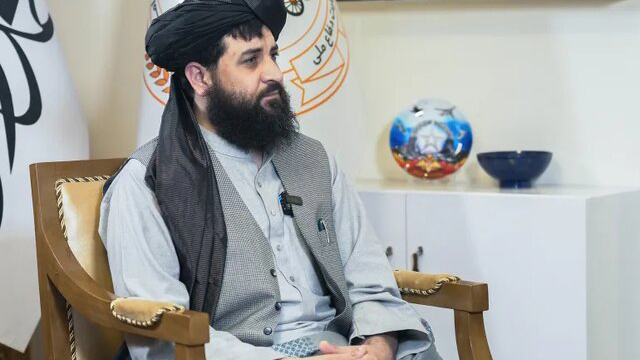
Tehran-IRAF- Mohammad Yaqoob Mujahid, the Taliban’s defense minister, said that Kabul is investigating the possibility of indirect U.S. involvement in Pakistan’s attacks on Afghan territory and examining whether these operations targeted weapons that the United States left behind after its withdrawal from Afghanistan in 2021.
In a special interview with the Al Jazeera news network’s website, Mujahid said that Pakistan may have received a plan from the United States to destroy these weapons. However, he added that in official consultations with the American side, they denied the issue. Nevertheless, what might be happening behind the scenes between the two sides is still under investigation until accurate information is obtained.
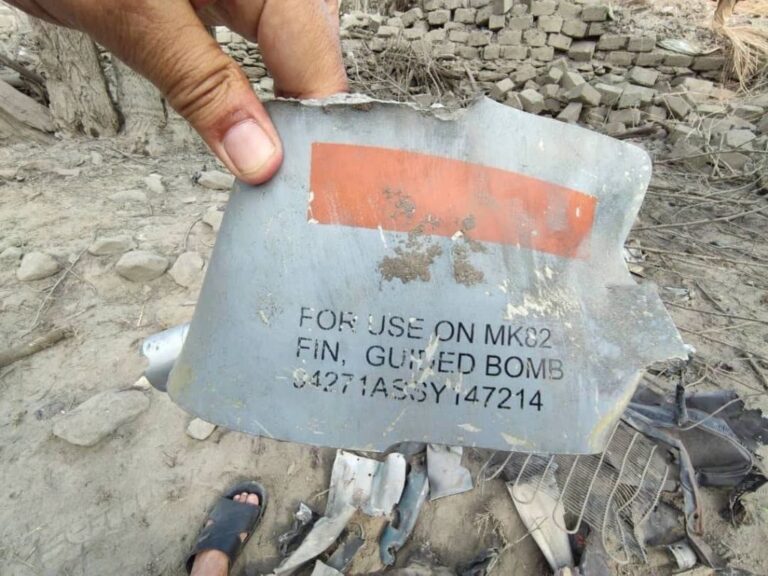
Pakistani fighter jets have carried out attacks on several military bases inside Afghanistan, including former U.S. bases and bases of the previous Afghan government. It is possible that the objective was to destroy weapons depots left behind by the United States in the country.
The Taliban’s Afghan defense minister told Al Jazeera that the root problem in Afghanistan–Pakistan relations lies in the policy of Pakistan’s military establishment, which is based on keeping the Afghan government weak and ensuring that Afghanistan remains a state with limited military capability. He added that Afghanistan’s economic dependence on Pakistani ports—especially the port of Karachi—gives Islamabad leverage to pressure Kabul and impose its political positions.
Kabul believes that Pakistan’s attacks have violated its border security.
A source within the Afghan government, who preferred to remain anonymous, told Al Jazeera that Afghan authorities were aware of a plan to destroy weapons that the Taliban had obtained from the United States.
The source added that Kabul moved a large portion of this equipment—especially sensitive weapons—to safer locations in and outside the capital.
Weapons Worth Billions of Dollars
While Islamabad insists that its operations targeted Tehrik-i-Taliban Pakistan (TTP) forces, some observers believe that the bases that were attacked raise questions about the possibility of other objectives behind the strikes.
During the U.S. withdrawal from Afghanistan in August 2021, American forces left behind large amounts of advanced military equipment, including armored vehicles, light aircraft, heavy weapons, and communication systems. U.S. reports estimated the value of this equipment at around seven billion dollars.
After the Taliban took power in Kabul, these weapons became part of the arsenal of the new government’s army. This raised concerns in the United States and some regional countries about the possibility of these weapons being used in regional conflicts or falling into the hands of armed groups.
Pakistan has stated that its military operations inside Afghanistan were in response to escalating attacks by Tehrik-i-Taliban Pakistan, which Kabul is accused of sheltering and cooperating with. However, experts say the attacks cannot simply be considered operations against TTP forces, as Islamabad claims.
Bashir Haidari, a strategic affairs researcher, told Al Jazeera that the bases that were targeted suggest broader calculations beyond merely confronting armed groups.
Haidari stated that the bombing of major military bases such as Bagram Air Base, the Special Forces headquarters in Kabul, Kandahar Airport, Jalalabad, and military centers in Laghman and Paktia provinces indicates that Pakistan is seeking to reduce the military capabilities of Afghanistan’s current government, particularly the weapons left behind by the United States.
The expert added that destroying these weapons—if it was an implicit objective—could simultaneously serve the interests of multiple parties. On one hand, Pakistan wants to reduce the Taliban’s capacity to pressure it; on the other hand, the United States may seek to reduce military equipment that is outside its control.
Since the U.S. withdrawal from Afghanistan, American political figures—including U.S. President Donald Trump—have expressed concern about advanced American military equipment remaining in the hands of the Taliban. Trump has repeatedly called for these weapons to be returned or destroyed.
Abdullah Khan, a researcher at the Kabul Center for Strategic Studies, also told Al Jazeera that Pakistan may see this issue as an opportunity to strengthen its relations with Washington. If Pakistan’s attacks actually lead to the destruction of some of these weapons, it could achieve an unspoken U.S. objective, even if there is no formal agreement between the two sides.
He added that Islamabad could benefit from this convergence of interests, especially as it seeks to rebuild its relations with the United States after years of tension.
Multiple Messages
Beyond the security dimension, Afghan analyst Karim Soltani told Al Jazeera that military operations also carry multiple political messages, as Pakistan seeks to demonstrate its influence over Afghanistan’s political dynamics.
Soltani added that Islamabad wants to show Kabul that if it continues supporting Tehrik-i-Taliban Pakistan, Pakistan can weaken it militarily. The operation may also send a message to India that Pakistan remains the most influential actor in Afghanistan.
However, the military tensions between Pakistan and Afghanistan have raised concerns in China, which has major economic interests in the region—particularly in the China–Pakistan Economic Corridor.
In this regard, international relations expert Hashim Jalali told Al Jazeera that Beijing is worried that the continuation of this conflict could weaken regional stability. While China understands Afghanistan’s security concerns, it prefers that the crisis be resolved through dialogue, as any military escalation could endanger its economic projects in the region.
A New Phase
In response, Afghanistan retaliated against Pakistan’s airstrikes with drone attacks across the border, a development that indicates the conflict between the two sides has entered a more dangerous phase.
Some analysts believe that the continuation of this trend—especially if airstrikes persist and larger military infrastructure becomes targeted—could turn the Afghanistan–Pakistan border into an open battlefield.
Amanullah Andar, a researcher, warned in an interview with Al Jazeera that weakening Kabul militarily could have unpredictable consequences. He said that Afghanistan, already fragile, could move toward a new wave of security chaos if the conflict escalates.
With tensions continuing along the Afghanistan–Pakistan border and both sides carrying out retaliatory attacks, the region appears to be on the verge of a new stage of conflict—one in which the weapons left behind by the United States in Afghanistan may become a key factor in reshaping the balance of power in South Asia.