Iran said on Monday that a new security pact between Turkey, Pakistan and Saudi Arabia reflected a growing regional shift away from reliance on Western powers for security, while warning that the full reopening of the Strait of Hormuz would require the complete lifting of a U.S. naval blockade.
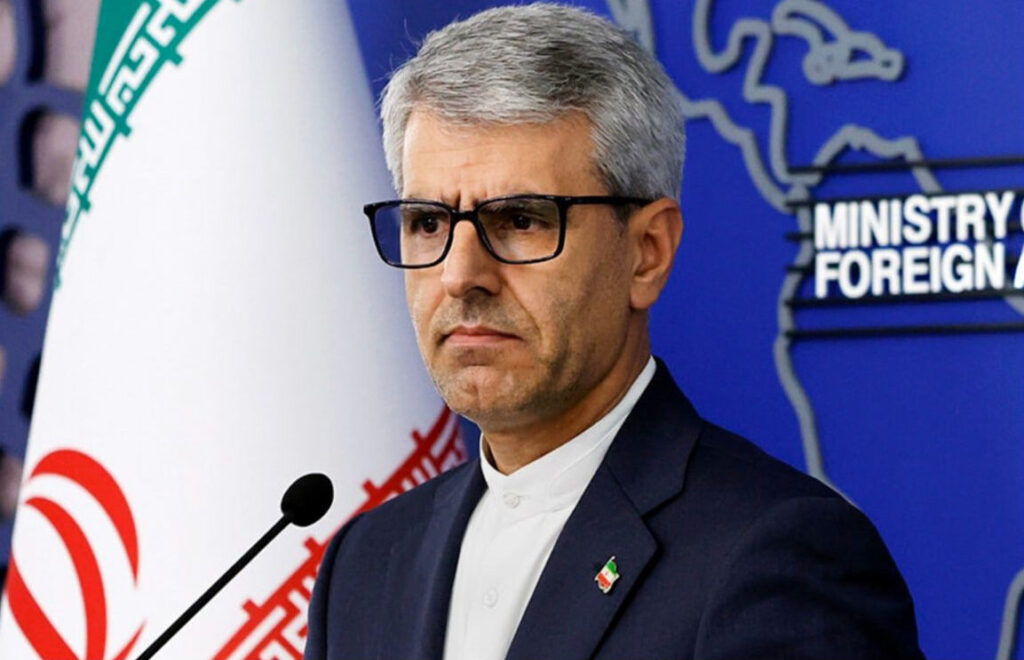
Speaking at a weekly news conference, Iranian Foreign Ministry spokesperson Esmaeil Baghaei said Tehran had been informed by Ankara and Islamabad about the three-way security understanding, widely referred to as the “Mecca Pact,” before it was finalized.
Baghaei said the security arrangements reflected a changing perception of regional security following three years of developments in Gaza and Lebanon and what he described as Israeli aggression.
“Security is not a commodity that can be bought from false brokers,”
Baghaei said, arguing that U.S. claims to provide security had proved to be an illusion.
He said Iran had historically been among the first countries to propose regional security initiatives, including the “Hormuz Peace Initiative,” aimed at creating an indigenous security framework, adding that such proposals could be updated.
Given what he described as deep religious and civilizational ties between Iran, Turkey, Pakistan and Saudi Arabia, Baghaei said Tehran had no concerns that the pact was directed against Iran.
Iran, he added, would welcome any independent regional mechanism that correctly identified Israel as the main threat.
Tehran says Oman agreement not enough to reopen Strait of Hormuz
A significant part of the briefing focused on technical discussions between Iran and Oman over a new navigation route through the Strait of Hormuz.
Baghaei said the two sides had reached an understanding on a navigation map and were continuing consultations to finalize a joint statement.
But he said an agreement with Oman was necessary, not sufficient, to ensure the full security of navigation through the strait.
He attributed the closure of the waterway to what he called military aggression by the United States and Israel and the use of bases on the southern shores of the Persian Gulf for operations against Iran.
Citing U.N. General Assembly Resolution 3314, Baghaei said the continuation of the U.S. naval blockade constituted “an act of aggression and a continuation of the war.”
He said full security in the Strait of Hormuz could not be restored until Washington stopped and compensated for what Iran considers illegal actions, which he said had resumed only three weeks after the signing of a memorandum of understanding to end the war.
The planned arrangements would also cover maritime services, environmental protection and monitoring of safe navigation, he said, adding that charging fees for maritime services was normal under international mechanisms.
Iran warns Kuwait over consular access, closure of Iranian school
Baghaei also criticized Kuwait over what he described as its refusal to provide consular access to four detained Iranian nationals, saying the request was legitimate and calling for their immediate release.
He also criticized Kuwait’s closure of a long-established Iranian school, calling it a “strange, political act and revenge against students.”
Baghaei urged Kuwait to avoid what he called unconstructive behavior and not allow its territory and facilities to be used by the United States for what Iran considers aggressive actions against the Islamic Republic.
Iran rejects foreign pressure over Caspian Sea convention
On the Convention on the Legal Status of the Caspian Sea, Baghaei rejected speculation that foreign pressure was influencing the timing of its submission to parliament for ratification.
He said the document had undergone seven years of review by senior Iranian institutions since 2018 and stressed that Iran would make its decision solely on the basis of national interests.
Final approval, he said, would rest with Iran’s parliament.
Baghaei also linked the withdrawal of countries including Chad and Venezuela from the International Criminal Court (ICC) to what he described as “selective justice” and U.S. threats against the court’s prosecutor and judges over the case involving Israel’s alleged genocide.
He said the developments had contributed to growing disappointment in the international community and a setback for international efforts to combat impunity.
No decision yet on Iranian president’s U.N. visit
Asked whether Iran’s president would attend the upcoming U.N. General Assembly session in New York, Baghaei said no final decision had been made.
He said the government would assess developments and conditions over the coming weeks before announcing a decision.
Addressing questions about his recent, more sarcastic responses to U.S. President Donald Trump, Baghaei cited a remark attributed to George Bernard Shaw.
He said Iran would use its rich cultural and civilizational resources in confronting its adversaries, but added that when dealing with what he described as the other side’s degrading behavior, “getting muddy is sometimes unavoidable.”