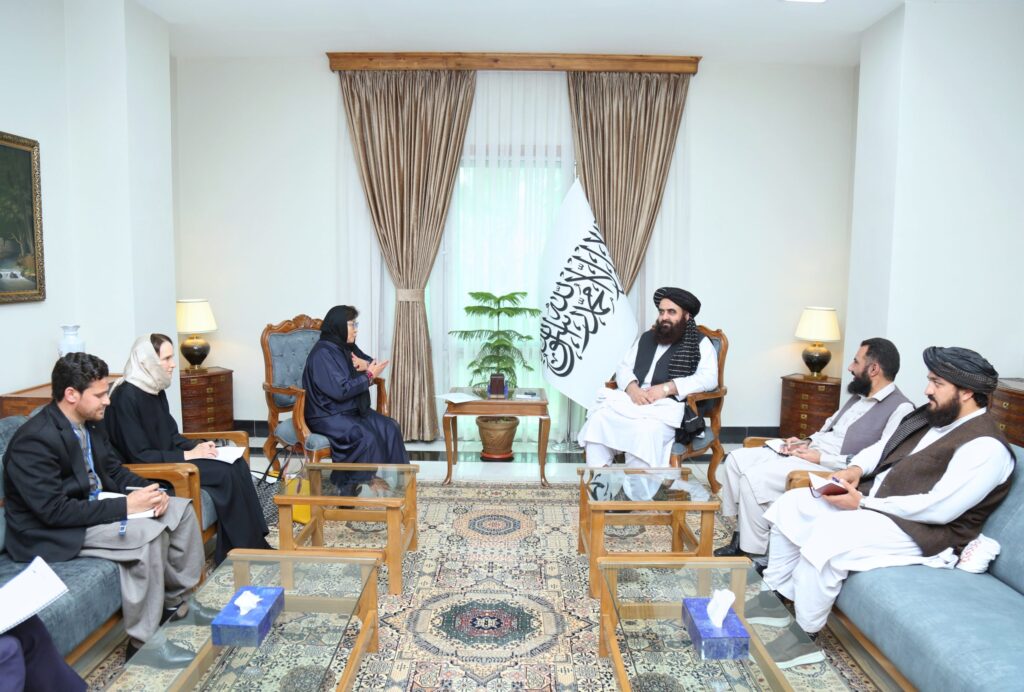
According to Iraf, Amir Khan Muttaqi, the Taliban’s acting foreign minister, met on Tuesday, May 19, 2026, in Kabul with Georgette Gagnon, the acting head of the United Nations Assistance Mission in Afghanistan (UNAMA).
During the meeting, Muttaqi once again urged the United Nations to transfer Afghanistan’s seat — currently held by Nasir Ahmad Faiq, a diplomat representing the former Afghan government — to the Taliban administration.
Over recent years, Faiq has criticized Taliban policies during UN Security Council meetings and opposed granting official recognition to the group.
According to a statement issued by the Taliban’s Foreign Ministry, the two sides discussed the upcoming UN Security Council session on Afghanistan as well as issues related to UN cooperation.
Muttaqi described the presence of Taliban representatives at the United Nations and other international institutions as “the right of the Afghan people,” claiming that such representation could pave the way for broader engagement with the international community.
According to the Taliban, Gagnon also emphasized during the meeting the continuation of UN cooperation across various sectors and the importance of sustained international engagement with Afghanistan.
The Taliban has controlled Afghanistan for nearly five years; however, apart from Russia, no other country, nor the United Nations, has recognized the group as the official government of Afghanistan.
Over these years, the UN Credentials Committee has repeatedly rejected the Taliban’s requests to assume Afghanistan’s seat, stressing that the group still falls far short of the requirements necessary for international recognition.
The United Nations has repeatedly urged the Taliban that, should it seek expanded relations with the international community, it must respect human rights, women’s rights, the rights of ethnic and religious minorities, as well as Afghanistan’s social diversity.
Nevertheless, the Taliban says it remains committed to human rights “within the framework of religious values” and considers those values non-negotiable.
Hibatullah Akhundzada, the Taliban’s supreme leader, had previously stated that the group would not retreat from implementing Sharia law in order to gain the approval of Western countries.
The Taliban also considers restrictions imposed on women — including bans on girls’ education and limitations on women’s employment — to be consistent with its interpretation of Islamic teachings, while a number of Islamic countries have stressed that such restrictions have no basis in Islamic law.
To further develop coverage of this issue, one could examine the diplomatic implications of the Taliban’s request or analyze the reasons behind the repeated rejection of Afghanistan’s UN seat transfer.