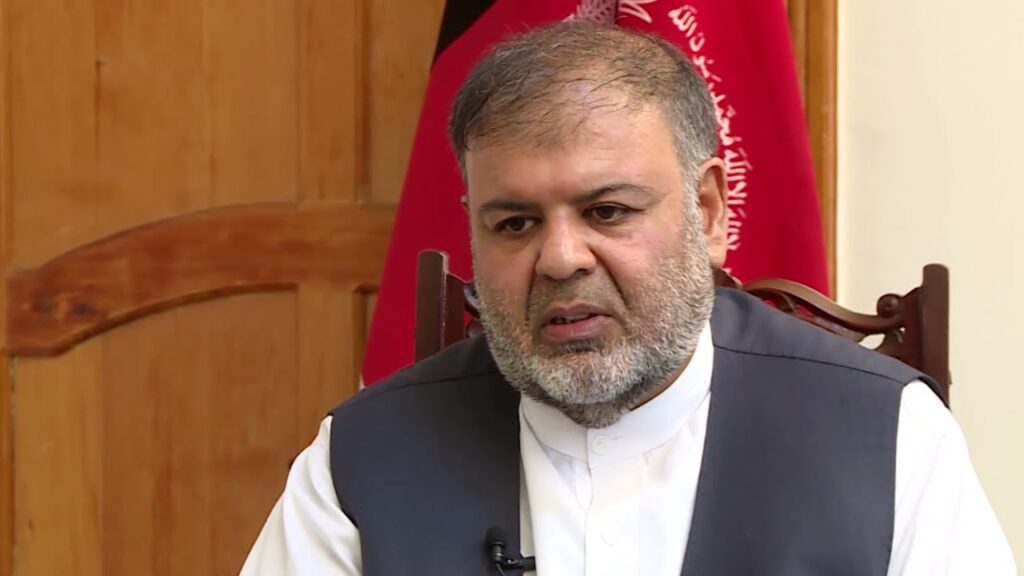
According to Iraf, Karim Khurram, Afghanistan’s former Minister of Information and Culture, commented on former U.S. President Donald Trump’s recent visit to China and his meeting with Xi Jinping, stating that contrary to what has been widely discussed in recent years about the “Thucydides Trap,” the current global order aligns more closely with the theory of the “Kindleberger Trap.”
He added that the concept of the “Thucydides Trap” gained greater prominence after the Chinese president referenced it in a recent meeting with Trump. The theory suggests the possibility of confrontation between a dominant global power and a rising power, potentially even leading to war.
Khurram stated, however, that what is currently observable in the world resembles the “Kindleberger Trap” more closely: a situation in which a dominant global power is in decline, while the rising power is unwilling to assume global leadership, thereby creating a vacuum in the international system.
He explained that the “Kindleberger Trap” is derived from the views of American economist Charles Kindleberger regarding the Great Depression of the 1930s, and it describes a period in which the United States was unwilling to replace Britain as the dominant global power.
Khurram added that China, despite its growing economic strength and position, does not appear willing to assume the role of global leadership. According to him, Chinese officials have repeatedly emphasized that, unlike Western colonial powers, their approach has not been based on domination or territorial occupation.
He further stated that China still lacks sufficient experience to function as a global hegemon and faces limitations in the field of international diplomacy.
Khurram pointed to Beijing’s unsuccessful attempt to organize a meeting similar to the Moscow talks on Afghanistan, adding that although China succeeded in facilitating rapprochement between Iran and Saudi Arabia, internal disagreements during the recent BRICS foreign ministers’ meeting demonstrated that Beijing still faces significant challenges in building global consensus.
He also noted that China lacks a traditional model of alliance-building on a global scale, and it is unlikely that Russia would support China’s full emergence as an uncontested global power.
Khurram added that Beijing is primarily focused on trade and economic interests and is unwilling to bear the heavy costs associated with global leadership in the way the United States has done. He noted that even after the U.S. withdrawal from Afghanistan, Washington continues to bear certain costs, while China has not demonstrated comparable levels of broad economic engagement.
He further stated that Chinese economic projects in several African and Asian countries have faced criticism over heavy debt burdens, citing Sri Lanka as an example where such issues contributed to political and social unrest.
Khurram also said that China has limited experience in using “soft power,” and despite efforts to expand the international use of the yuan in global trade, it is not inclined to turn it into a global reserve currency.
In conclusion, Khurram warned that in the coming years the world is likely to face a leadership vacuum and move toward a multipolar order. Such a situation, he argued, could lead to prolonged conflicts, increased trade crises, and the weakening of international organizations.
He added that under these conditions, weaker countries would come under greater pressure from regional powers, and instability would increase across various parts of the world.