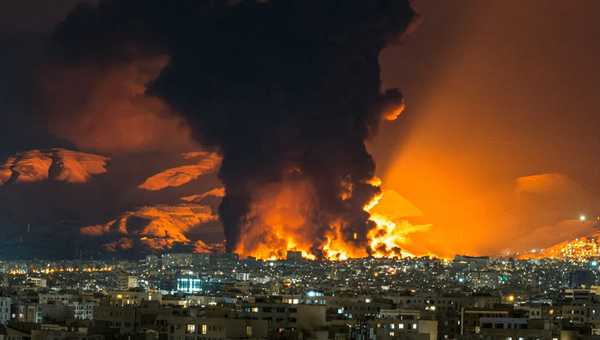
On the 28th of February of this year, the criminal United States, together with the Zionist regime, launched an imposed war against the Islamic Republic of Iran. In the early morning attack on Saturday, February 28, the senior Supreme Leader of the Islamic Revolution of Iran, Ayatollah Seyyed Ali Khamenei, along with several military commanders, was martyred. American‑Zionist leaders believed that by assassinating Iran’s leader, order inside the country would collapse and they would easily be able to bring this vast land under their control. However, not only did the system not collapse, but it continues to fight with strength against the American‑Zionist enemy in defense of its people and territory.
Since the beginning of the war, Iran has carried out numerous strikes targeting the occupied territories and U.S. bases across the Middle East—attacks that have inflicted heavy and significant losses on the United States and its usurping ally. U.S. think tanks and intelligence and military institutions have been assessing Iran’s resilience and its methods of warfare throughout the conflict.
The assessment of the U.S. National Intelligence Council demonstrates a deep understanding of the structures and institutions of the Islamic Republic. According to the data of this body, as long as the clerical structure and Iran’s military institutions remain in power, the United States’ ability to politically intervene and manipulate Iran’s internal affairs will remain extremely limited.
It should be noted that Imam Khomeini and other founders of the Islamic Revolution designed the institutions of the Islamic Republic over past decades not only for governance but also for resistance against wars and assassinations. Therefore, the Iranian government is not a one‑man show. Unlike countries such as Syria and Libya under the rule of the Assad and Gaddafi families—whose regimes were built around ruling families—once those families were removed from power, the regimes collapsed. Gaddafi was killed and Bashar al‑Assad fled, leading to the collapse of their respective political systems.
Regional Dimensions of the American‑Zionist War Against Iran
The world is closely watching how the attacks by the United States and the Israeli regime against Iran and Iran’s retaliatory responses are developing and how they are affecting the regional situation in the Middle East.
The military actions carried out by the United States and the Zionist regime against Iran have significantly weakened regional security in the Middle East. This war was initiated by the United States without any legal or rational justification. Before the war, Donald Trump claimed that Iran was developing missiles capable of reaching the United States—an allegation that has not been confirmed by U.S. intelligence agencies.
He also claimed that Iran was close to developing nuclear weapons, a claim that contradicts his own statements last summer in which he said the United States had destroyed Iran’s nuclear sites.
Therefore, without legal justification, American and Zionist leaders carried out targeted attacks against a sovereign nation. This action undoubtedly delivers a severe shock to the international order established after World War II. This new round of military actions against Iran will likely intensify fear and insecurity among countries in the region and negatively affect future relations between the United States and Arab states.
The war imposed on Iran by American‑Zionist leaders undoubtedly has regional and international dimensions. Iran holds a critical geopolitical and geostrategic position, and any action taken by or against it will have regional and international consequences.
Iran is a vast country bordering Azerbaijan, Armenia, Georgia, and Turkmenistan to the north; Afghanistan and Pakistan to the east; Turkey, Iraq, and Kuwait to the west; and the Arab states of the Persian Gulf to the south. Each of these neighboring countries faces its own political, economic, and social challenges. Because Iran’s population consists of diverse ethnic and religious groups, any instability within the country could potentially spread beyond its borders. Given that Iran is the main center of Shiite political influence in the region, military actions against it could intensify sectarian tensions.
The presence of the Strait of Hormuz within Iran’s territorial waters further enhances its geostrategic importance. Before the war, thousands of ships and oil tankers passed through this international waterway every day, and any disruption to this traffic has a direct impact on the global economy. Since the beginning of the war, global prices of oil and diesel have risen sharply due to disruptions in tanker traffic through the Strait of Hormuz. Experts predict that if oil prices reach $150 per barrel, the global economy could collapse.
In addition, over past decades the United States has used exaggerated and unfounded claims about the Iranian threat to Arab countries in the Middle East as a pretext to establish military bases around Iran. Since the start of the war, Washington has used these bases to attack Iran. Consequently, the Islamic Republic of Iran has targeted U.S. bases in neighboring Arab countries, including Saudi Arabia, Oman, Qatar, Bahrain, Kuwait, Jordan, and Iraq, causing substantial damage.
From a security perspective, Saudi Arabia and other Gulf states have spent the past few days attempting to intercept Iranian missiles and drones. Despite constant pressure, Iran continues to demonstrate its capacity to launch missiles and drones toward the Israeli regime and U.S. bases in Arab countries.
The security architecture of the Middle East is now facing severe challenges, and military tensions among Iran, the Israeli regime, and the United States may become prolonged. Strategically, their disagreements over core interests and regional influence are structural. Moreover, the forms of confrontation between them are likely to become increasingly diverse and asymmetric.
In addition to conventional military conflict, cyberattacks, proxy wars, political and media campaigns, and diplomatic competition in international forums may all become enduring features of the region.
Military actions against Iran have once again drawn international attention to the unilateral and arbitrary behavior of Trump in international affairs. Although the United States is one of the five permanent members of the United Nations Security Council, by attacking a sovereign nation it has taken the lead in undermining international law. Therefore, it is not an exaggeration to describe Washington as a primary cause of turmoil in the Middle East.
Following the military aggression against Iran, a wave of opposition emerged from the international community. United Nations Secretary‑General António Guterres emphasized that the UN Charter provides the foundation for maintaining international peace and security and that all member states must respect their obligations under international law. Member states of the Shanghai Cooperation Organization also issued a statement declaring the use of force unacceptable and asserting that the only solution to the current conflict is dialogue, mutual respect, and attention to the legitimate concerns of all parties in accordance with international law and the principles of the UN Charter. The Arab League also called on all actors in the international community to work urgently toward reducing tensions and preventing the region from suffering the devastating consequences of expanding instability and violence.
Therefore, military operations must be stopped immediately. The tragic attack on an elementary school in Minab by the criminal U.S. regime has struck a blow to the moral red lines of humanity. As the humanitarian catastrophe intensifies, the security of the Strait of Hormuz—a vital route for global energy trade—has also been severely affected, and the risk of additional forces entering the conflict is rapidly increasing.