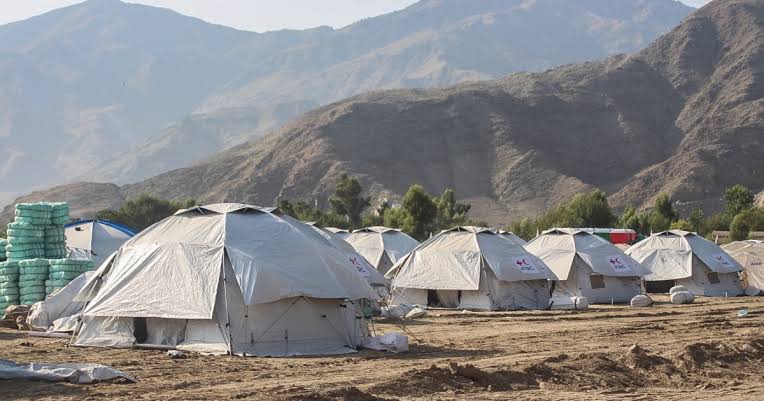
A year after a magnitude 6 earthquake struck eastern Afghanistan, killing hundreds and destroying thousands of homes, many survivors in Kunar province are still living in temporary tents and waiting for emergency assistance, permanent shelter and the chance to rebuild their lives.
The earthquake struck shortly after midnight on Sept. 1 last year, while people were asleep. Its epicenter was near the border between Nangarhar and Kunar provinces, at a depth of between 8 and 10 kilometers.
Initial reports indicated extensive destruction in Kunar, with 800 people killed and another 2,500 injured.
Rescue and relief operations faced major obstacles in the first days after the quake as communications with affected areas were cut and parts of the road network were damaged. The reported death toll and scale of destruction continued to rise as access to remote areas improved. Several villages in mountainous and difficult-to-reach areas were completely destroyed.
Assessments carried out by independent organizations after the disaster found that around 8,300 homes in Kunar, Nangarhar and Laghman provinces had been severely damaged. Of those, 6,200 were completely destroyed and rendered uninhabitable.
Landslides and rockfalls triggered by the earthquake in some mountainous areas further complicated conditions for survivors who had lost their homes, possessions and sources of income. Many rural families in the affected areas had already been struggling with poverty and deprivation before the earthquake, leaving them particularly vulnerable to the aftermath of the disaster.
The destruction also extended beyond homes. Roads, service centers and other public infrastructure were damaged, making it harder for families to return to normal life and increasing the need for reconstruction beyond simply rebuilding houses.
International humanitarian assistance and relief operations began in the immediate aftermath of the earthquake. But the scale of the disaster, limited resources and damaged roads slowed the distribution of aid.
A year later, the United Nations Office for the Coordination of Humanitarian Affairs (OCHA) says hundreds of affected families remain in critical conditions. Many of those who moved into temporary shelters after the earthquake are still living in tents and require urgent assistance to rebuild their lives.
Amy Martin, an OCHA staff member involved closely in the relief response, said that despite initial assistance reaching thousands of people, hundreds remained in extremely difficult conditions and still needed urgent help.
In the months following the earthquake, humanitarian organizations distributed food, water, hygiene supplies, temporary shelter and other essential items to some affected families. But much of that assistance was designed to address immediate needs and did not provide a lasting solution for families who had lost both their homes and livelihoods.
With winter approaching, hundreds of earthquake survivors still living in temporary tents face serious risks and urgently need permanent shelter. Weather forecasts point to heavy rainfall and severe cold this winter in the predominantly mountainous areas.
Some affected families who met with U.N. officials have called for urgent relocation to safe areas and permanent housing, as well as improved living conditions.
Despite extensive humanitarian assistance sent to earthquake victims by countries including Iran, Russia, China, the United Arab Emirates, Turkey and Japan, many survivors still require immediate support.
Access to healthcare, medical services and clean water remains another major concern. Continued life in temporary tents, particularly in mountainous and cold areas, increases health risks and leaves children, older people and low-income families especially vulnerable.
The earthquake also destroyed important sources of income for rural families.
Many agricultural fields were severely damaged and rendered unusable, while livestock died and other basic resources on which rural livelihoods depended were lost. As a result, surviving families continue to face a crisis without emergency assistance.
A joint assessment by the United Nations, the European Union and the World Bank estimated the earthquake’s damage at $86.8 million and put the cost of reconstruction and recovery in affected areas at $128.8 million.
With part of the local economic base destroyed, restoring livelihoods is as important as rebuilding homes. Rehabilitating farmland, replacing lost livestock and providing the means for families to resume economic activities could help reduce their long-term dependence on humanitarian aid.
Meanwhile, Afghanistan’s Taliban-run Defense Ministry says it has built and handed over 36 homes to earthquake-affected families in Kunar over the past year.
That figure is a fraction of the 8,300 homes reported damaged across the three affected provinces, underscoring the gap between the scale of destruction and the pace of reconstruction.
A year after the Kunar earthquake, survivors are again approaching winter facing a second year in temporary tents, with limited access to healthcare, sanitation and other basic services as they wait for promised assistance and more permanent solutions.