Five years after the Taliban returned to power, Afghanistan’s economy continues to face a range of domestic and regional challenges, from infrastructure development and attracting domestic and foreign investment to trade, transit routes, relations with neighboring countries, water management, mining and efforts to combat drug cultivation. Iran, given its shared border with Afghanistan, trade and transit potential and the role of Chabahar port, remains one of Afghanistan’s key economic partners.
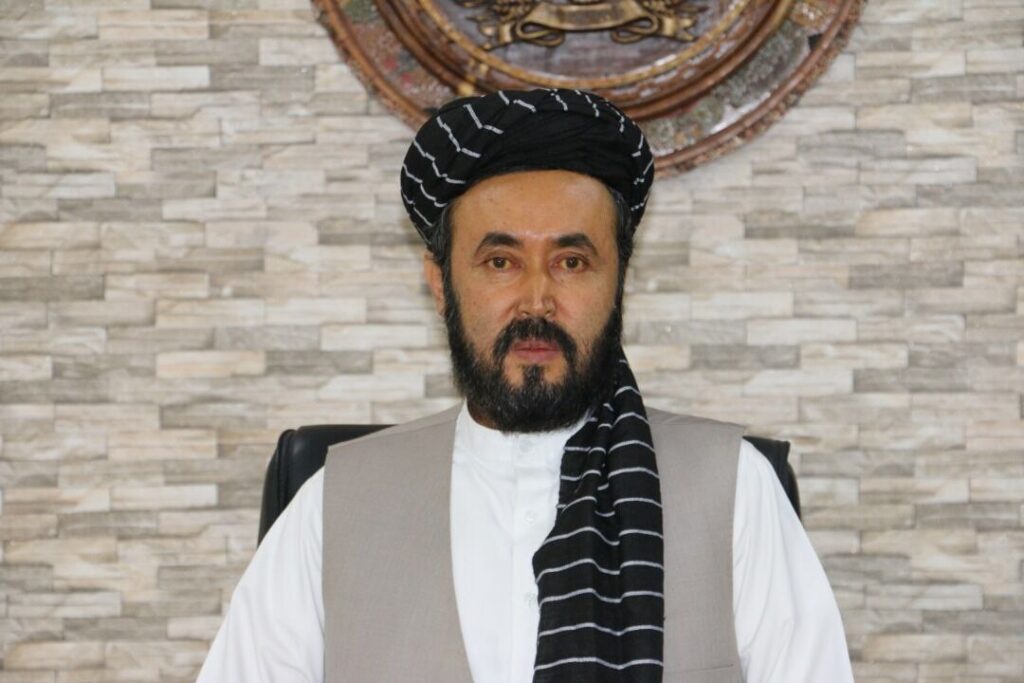
In an exclusive interview with IRAF, Abdul Latif Nazari, Taliban deputy economy minister, outlined what he described as the Taliban government’s economic achievements over the past five years, including infrastructure projects, road development, expanded economic ties with Iran, China, Russia and Central Asian countries, and efforts to activate new transit routes.
Nazari also addressed questions about the situation in Badakhshan, gold mining and drug cultivation, relations with Pakistan, the impact of regional conflicts on ties between Kabul and Tehran, Iranian investment in Afghanistan, water rights, the Wakhan Corridor, the status of Shia housing estates and the closure of Tamadon television.
Taliban economic projects: From water management to road development
Asked about the Taliban’s main economic achievements over the past five years and the major projects carried out during this period, Nazari said:
“In fact, over the past five years that the Islamic Emirate (the Taliban government) has been in power in Afghanistan, it has managed and implemented various economic projects, one of which is the Qosh Tepa project in northern Afghanistan, which is almost unprecedented in the history of Afghanistan.”
He continued:
“This project has both created employment, played a role in managing Afghanistan’s water, and settled a number of Afghans, for whom industrial townships will be built alongside this canal in the future, and development and construction have also taken place there. Therefore, in our view, this project is not only a water-related project, but can also have an impact on various sectors of the economy, employment, settlement and industrial development.”
On road construction, the Taliban deputy economy minister said:
“Alongside this, the reconstruction and modernization of Afghanistan’s roads and highways are progressing strongly and intensively, both in Afghanistan’s major cities and on its main highways, which is a very important point; because it connects Afghanistan’s cities to one another and also connects villages, rural communities and remote areas of Afghanistan to the cities and provincial centers.”
Nazari added:
“Therefore, it can play a very important and fundamental role in facilitating transportation and reducing transportation costs. When cities, villages and remote areas are connected to one another, the conditions for the movement of goods, the movement of people and greater economic activity are created, and ultimately this can help reduce transportation costs and boost the economy.”
On investment and Afghanistan’s economic relations with regional countries, he said:
“There has been significant progress in the area of investment. We have extensive economic relations with Central Asian countries, with China and Russia, and our relations with the Islamic Republic of Iran are also developing in the economic sphere, and these are major achievements that we can call economic activity and economic prosperity.”
Badakhshan: Gold mines and the dispute over drugs
Asked about disputes and tensions surrounding mining in Badakhshan, Nazari said:
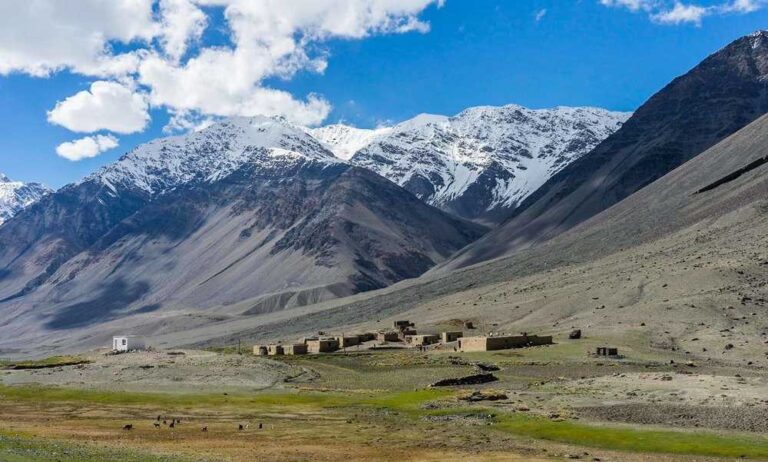
“The Badakhshan region is one of the strategic and geopolitically important regions, because it is adjacent to Pakistan, adjacent to China, and also adjacent to Central Asia, including Tajikistan.”
He continued:
“Some countries that are involved in escalating insecurity in Badakhshan, and some, gold and drugs are also among the issues in dispute. Some are trying to gain control over Afghanistan’s mines; that is, the mines that exist in Badakhshan, particularly gold mines, and some are trying to cultivate drugs there and make more money through them.”
Nazari said the Taliban had banned drugs both in principle and in practice:
“The Islamic Emirate (the Taliban government), as you are aware, has declared drugs forbidden at the theoretical level, banned their cultivation, and at the practical level security forces have tried to prevent the cultivation of drugs so that Afghanistan can be freed forever from this destructive scourge, which has harmed both Afghanistan and neighboring countries.”
He added:
“That is why there are still some people in different parts of Afghanistan who resist this policy. Unfortunately, in Badakhshan as well, there are a small number of people who want to continue exploiting drugs as a profitable product and cultivate them in a way that continues the culture of the past that existed during the occupation of Afghanistan; that is, the excessive and widespread cultivation of drugs.”
Nazari also referred to the period of the presence of foreign forces in Afghanistan, saying:
“Because drugs were widely cultivated during the occupation of Afghanistan by the United States and NATO, and even deliberate efforts were made to make Afghanistan’s youth addicted so that this colonial force could advance its policies in any country where it exerted influence. Therefore, the customs and culture still remain in some parts of Afghanistan, and this requires a fight.”
He said the Taliban wanted to eradicate drugs throughout Afghanistan:
“Because the Islamic Emirate (the Taliban government) wants drugs to be eradicated throughout Afghanistan, such problems still occur from time to time in some Afghan provinces.”
“Afghanistan has entered a new chapter”
Asked about warnings by some Taliban opponents regarding Badakhshan and Afghanistan’s national interests, Nazari said:
“The reality of the matter is that Afghanistan has entered a new chapter. When they were in power in Afghanistan, what achievements did they have? If they had good achievements, Afghanistan would not have fallen; that is, it would not have slipped away from them in such a way.”
He continued:
“Because they had lost their social base, we saw that very quickly after the withdrawal of the occupying forces from Afghanistan, that government dependent on foreigners collapsed. Therefore, those who are currently presented as opponents, because of their past performance, because of their dependence on foreigners and outsiders, and also because of their weak performance, do not have a social base among the people of Afghanistan.”
The Taliban official added:
“Afghanistan was the most corrupt country in the world during the occupation. Afghanistan under previous governments was a country full of corruption and, in fact, identity and ethnic divisions and social cleavages. Foreigners, of course, played a prominent role in these divisions, and likewise in the area of employment, Afghanistan continued to face an unemployment crisis during the occupation, despite the money that was claimed to have flowed into Afghanistan.”
He said:
“The fact that Afghanistan should move toward war and instability, and talk that deepens social divisions and provokes public opinion, is rejected by the people of Afghanistan. The people of Afghanistan are tired of war and conflict and want lasting stability to be established in Afghanistan.”
Afghanistan’s relations with Pakistan and Iran: From border tensions to expanding trade
On Afghanistan’s relations with neighboring countries, particularly Pakistan and Iran, Nazari said:
“Our relations with Pakistan are tense and the country’s economic and trade activity has stopped. Of course, Afghanistan is pursuing a policy of de-escalation and confidence-building with its neighbors and has defined this in its foreign policy, but unfortunately tensions between Afghanistan and Pakistan have led to the closure of the country’s borders and ports.”
On Iran, he said:
“But our relations with the Islamic Republic of Iran are good relations, accompanied by mutual respect and non-interference. The economic and trade relations between the two countries are also desirable, and as time passes we are witnessing an opening in relations between Afghanistan and Iran.”
Nazari added:
“The delegations that hold talks between the two countries and travel to Kabul and vice versa to Tehran and Mashhad, we are witnessing the development of economic, trade and transit relations. These visits and talks help develop relations between the two countries in various fields, and we are seeing that economic and trade ties between the two sides continue to develop.”
On Iran’s Chabahar port, he said:
“Chabahar port is one of the issues that can provide mutual benefits and play an important and fundamental role in economic exchanges between the two sides. This port can play an important role in the transfer of goods and development of Afghanistan’s trade and help expand economic relations between the two countries.”
Nazari added:
“The Khaf-Herat railway is also a real connection between the two countries, and has facilitated economic exchanges between the two countries and boosted the country’s trade. Also, in terms of being neighbors, that is, border issues, fortunately we are currently in a state of calm, and the issues have been almost resolved, and overall I can say that Afghanistan and Iran currently have good neighborly relations.”
Iran war and the Strait of Hormuz: Afghanistan’s trade continues
Asked about recent developments in Iran and what he called the “U.S. and Israeli regime’s aggression against the neighboring country,” Nazari said:
“Despite the aggression that the United States and the Israeli regime have carried out against our neighboring country, the Islamic Republic of Iran, we did not feel negative economic effects in Afghanistan.”
He continued:
“Even during the war, economic exchanges between the two countries continued and, in fact, Iran’s exports to Afghanistan continued, and at one point economic exchanges even increased. That is, border meetings were held and new border points between the two countries were opened.”
Nazari described relations between the two countries as deep, saying:
“The relations between the two countries are very deep and profound, which in fact means that even wartime conditions cannot affect this situation. Fortunately, we are seeing that even under the current circumstances, these relations exist between the two countries in a normal and conventional manner.”
On the Strait of Hormuz, he said:
“The closure of the Strait of Hormuz, in our view, is Iran’s legitimate right, Iran’s natural right. It did not have that much of an impact on Afghanistan’s economic situation.”
He attributed this to alternative routes:
“Some other corridors that are being activated in Afghanistan, for example, work on the Wakhan Corridor between us and China is underway, and Central Asian routes have been activated. These have caused Afghanistan’s economic situation, in fact, not to be affected by the closure of the Strait of Hormuz.”
Nazari said:
“Our economic situation is naturally continuing strongly at present, and we are not seeing any particular problem in Afghanistan’s imports and exports.”
Wakhan Corridor: Afghanistan’s new trade route with China
On the status of the Wakhan Corridor and reports that China has been cautious about reopening and activating the route because of security concerns, Nazari said:
“Some problems arise; security challenges occur even in developed countries, but the Islamic Emirate (the Taliban government) has control over all areas, and it wants to see greater success at the Wakhan port.”
He added:
“Even the Chinese promised that in this regard they would cooperate with Afghanistan in a special manner so that the work on this crossing would be managed and advanced seriously, so that we could actually see transportation through this route between the two countries and an expansion of trade between the two countries.”
Nazari said China was interested in expanding activity in Afghanistan:
“China is also interested in increasing activity in Afghanistan, and we are trying to make this route more active. The goal is for Afghanistan to be able to use the potential of its geographic position and expand regional trade and transportation through new routes.”
Iranian investors: “There is no serious problem in Afghanistan”
Asked about the activities of Iranian traders, merchants and investors, particularly in mining and infrastructure projects, Nazari said:
“Fortunately, there is no serious problem for Iranian traders, merchants and investors in Afghanistan, because we want to benefit from the experience of our neighboring country.”
He continued:
“We have a common language, we have common tastes, and Iranian products have buyers. In this way, if any Iranian investor invests inside Afghanistan, they will be cooperated with in various ways.”
On administrative procedures and investment regulations, he said:
“The bureaucracy that existed in the past does not currently exist, and the laws and regulations have become easier. We have no problem with their visa issuance and residence.”
He added:
“In terms of industrial townships, we provide land and townships to investors. They are citizens of Afghanistan; therefore, given the current situation, the conditions for Iranian investors inside our country are fully available.”
He said investment opportunities existed across several sectors:
“In industry, in agriculture or farming, in trade, energy, transportation; [there are investment opportunities] throughout Afghanistan.”
Iran’s water rights: Taliban blames drought for water shortages
Asked about the Taliban’s water policy and whether the government prevents water from the Helmand River from reaching Iran, Nazari said:
“The policy of the Islamic Emirate (the Taliban government) is never that, God forbid, water should not reach Iranian citizens and the honorable people of our neighbor.”
He explained:
“You know that Afghanistan has faced drought in recent years. Significant damage has been inflicted on the people of Afghanistan, and as a result of devastating floods in Afghanistan, our natural resources have been severely damaged.”
Nazari continued:
“But if there is not enough water, the leaders of the Islamic Emirate (the Taliban government) consider delivering water to neighbors their Islamic and religious duty under such circumstances. We do not want a Muslim neighbor to be deprived of water by another Muslim.”
He said:
“But unfortunately, I must say that the drought problem in Afghanistan has been very serious in recent years, and if obstacles have sometimes arisen in relation to water, it has been because of drought. There has been and will be no deliberate approach regarding the provision of Iran’s water rights.”
The Taliban deputy economy minister emphasized:
“We want to have good and friendly relations with our western neighbor, the Islamic Republic of Iran, accompanied by mutual respect and based on common interests.”
Seizure of Shia housing estates: Nazari stresses preventing harm to ordinary people
Regarding the situation of Afghanistan’s Shia community and restrictions attributed to the Taliban government, particularly the Nawabad township in Ghazni and Omid Sabz township in Kabul, Nazari said:
“Regarding the townships, people have not yet been removed from their homes and they are still living in those townships.”
He explained:
“I visited the Nawabad township in Ghazni province and spoke with the people of the area. The second township is Omid Sabz township in Kabul, where people are also still living in their homes.”
Nazari said he had recently spoken personally with the Taliban justice minister about both townships:
“Recently, I personally spoke with the Minister of Justice of the Islamic Emirate (the Taliban government) regarding both townships. The talks that took place there were good, useful, constructive and hopeful.”
He stressed:
“There is not supposed to be any right of the people there or in these two townships [violated]. On the other hand, you know that during the occupation, the prevailing official culture in Afghanistan was a culture of bullying and strong-arming, and there were various islands of power in different parts of Afghanistan.”
Nazari added:
“Therefore, the Islamic Emirate (the Taliban government) is determined to [eliminate] the culture of usurpation in Afghanistan and prevent the seizure of public property and the public treasury; but as a government, it also pays attention to the fact that the government’s duty is to provide shelter for citizens, create employment, provide security and provide public welfare. Therefore, it certainly pays attention to the fact that the people of Afghanistan should not become homeless. With this approach, it wants to combat the phenomenon of usurpation in Afghanistan; that is, to stop the usurper in the true sense of the word and fight against him.”
The Taliban official stressed:
“But it does not want the situation to become such that ordinary people and citizens who bought their homes and land with their own money are harmed. My talks with the Minister of Justice were also focused on ensuring that ordinary people are not harmed and that a crisis does not arise inside the country.”
Referring to returning migrants, he said:
“While we are trying to provide shelter for some migrants returning to Afghanistan from the two neighboring countries of Iran and Pakistan, attention must certainly also be paid to those living in Afghanistan so that they do not face problems.”
Talks continue over reopening Tamadon TV
On the closure of Tamadon television, Nazari said:
“Regarding Tamadon television, talks are still ongoing, and Shia leaders are trying, through discussion, dialogue, negotiation and an approach of interaction and understanding, to create the conditions for reopening Tamadon media.”
He added:
“These talks are still continuing, and our hope is that the talks will reach a positive result so that, God willing, the conditions for the reopening and resumption of Tamadon television’s activities will be provided.”
“I was not summoned by the justice minister”
Explaining his presence at a protest meeting by Shia scholars and his subsequent meeting with the Taliban justice minister, Nazari said:
“First, if some media outlets have reported it, it was a mistake, and second, I was not summoned by the Minister of Justice either.”
He continued:
“Again, one of the media outlets had published this news with the aim of provoking public opinion and perhaps damaging my reputation. Afghanistan International is a spy and Zionist network and, in fact, a network against Afghanistan’s national interests and the sister network of Iran International.”
Nazari explained that he had requested the meeting with the justice minister himself:
“In fact, I myself wanted to see the Minister of Justice, because of these two townships; Nawabad township in Ghazni and Omid Sabz township in Kabul. Because I also met with people in Ghazni, I had to raise the people’s demands as someone from the Shia community who is in the government. In fact, I was not summoned at all, and I was also not at the protest meeting (of Shia leaders in western Kabul), because I was traveling. Both matters were published, and our discussion with the Minister of Justice was also very constructive, useful, respectful, and there was no inappropriate treatment of any kind.”
Nazari also criticized reports published by Afghanistan International:
“The biased media outlet Afghanistan International published such a report, which is not unprecedented. In the past, they used to publish such reports.”
He alleged:
“Their goal is for a confrontation and a conflict to take place between the Shia community and the Islamic Emirate, and in this regard they have repeatedly published false news, fake news, unfortunately.”
Message to Afghanistan’s young generation: Do not fall into the trap of colonial conspiracies
At the end of his exclusive interview with IRAF, Nazari addressed the people of Afghanistan, particularly the country’s young generation:
“Let me remind the people of Afghanistan of one point, especially the young generation of Afghanistan who are active on social networks, that they should be careful because the conspiracy and plotting of the enemies of the people of Afghanistan continues. It is true that colonialism, arrogance, and the occupying and aggressor powers have left Afghanistan as a result of the people’s struggles, and their departure was also accompanied by humiliation. Therefore, they hold a grudge against the people of Afghanistan.”
Nazari continued:
“That is why they are trying to create and intensify ethnic and religious divisions among the people of Afghanistan. I ask the young generation to be vigilant, to be awake, and not to fall into the trap of the conspiracy and plotting of the enemies of the people of Afghanistan.”
He concluded:
“Work for a strong, united, free and prosperous Afghanistan so that all of us, under the light of a dignified and powerful country, can leave a good legacy for our future generations. A free, prosperous and independent, powerful, strong and united Afghanistan is in the interest of all the people of Afghanistan and in the interest of all ethnic groups of Afghanistan.”
Abdul Latif Nazari is one of the few Shia and Hazara figures serving in the Taliban government. Since his appointment as deputy economy minister, he has commented on Afghanistan’s economic situation and its relations with neighboring countries. He has also sought to represent Afghanistan’s Shia community within the Taliban government and convey Shia concerns to Taliban leaders over policies such as the seizure of housing estates and the closure of television networks and religious seminaries.