Tehran- IRAF- Citing Arab News, Rahime Alavi is one of more than five million people who have returned to Afghanistan since 2023 from Iran and Pakistan. The embroidery boutique run by 22-year-old Rahime Alavi is an unexpected and treasured sight in Bamiyan.
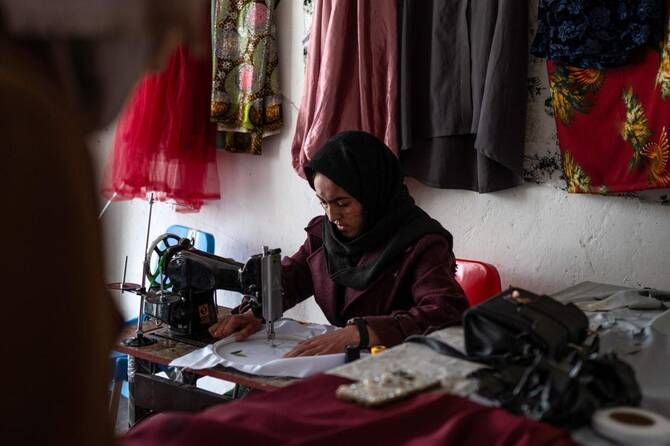
A small sign outside Alavi’s shop reads: “Spring flowers, tailoring and embroidery.” The shop opened in January after months of effort to get it running.
Wearing a burgundy coat with a few leftover colored threads clinging to it, Alavi says: “I really feel proud because I can support my family, my parents and my three sisters. I can pay the rent.”
As she demonstrates her newly acquired skills, she carefully guides fabric under the needle of her sewing machine to create delicate silk leaves and flowers.
Alavi is one of more than five million people who have returned to Afghanistan since 2023, following migrant return policies by Iran and Pakistan—countries that had hosted Afghans for decades.
Raised in a village in Bamiyan province, she helped her parents with farm work alongside her studies. Her family migrated to Iran in 2021.
“In Iran, there were more job opportunities, and both women and men could work,” Alavi says.
They earned a living harvesting cabbages near the central city of Isfahan, but returned to Afghanistan in 2024.
“My father couldn’t find work, and neither could my sisters or I. I was very disappointed because there was no work in Bamiyan,” she says, her smile fading.
According to a survey by the International Organization for Migration (IOM), only 1 percent of women returning from Iran or Pakistan have found full-time jobs, and just 2 percent have been able to start a business.
Alavi struggled for months until she and 25 other women were selected for embroidery training under a program supported by the UN refugee agency.
“Gradually, hope came back to my heart, and after completing the course, my hope grew even stronger,” she says.
She was provided with a set of equipment, including a sewing machine, fabric, and cash to purchase a solar panel—an essential tool in a country where power outages are common.
Her instructor, Reyhana Darabi, describes Alavi as “very capable and very talented,” adding: “She was so committed that she never missed a single class session and learned whatever was necessary the very same day.”
However, Darabi lost her job in December when the training program was halted as part of broader cuts to international aid across Afghanistan.
So far, Alavi is the only woman among the program’s participants who has managed to start an independent business, with support from her best friend—a success that has made those around her proud.
“We were truly happy women,” Darabi says. “Women in Afghanistan today—not only in Bamiyan but across the country—face challenges and restrictive regulations, and they are only allowed to work in limited fields such as handicrafts.”
Alavi has called on donors and international organizations to resume training programs, emphasizing: “There is no work here for women.”
Last year, women made up the majority of nearly 2,400 people trained under programs run by the United Nations High Commissioner for Refugees (UNHCR).
The agency has stated that it requires $216 million this year to support displaced people and returnees across Afghanistan, but so far only 8 percent of that amount has been funded.
As opportunities continue to shrink, Alavi encourages other women returning to Afghanistan to seize any job opportunity that arises.
“Don’t sit at home,” she says, standing among embroidered dresses, scarves, and tablecloths.
On one of the scarves she says she would like to wear herself, purple butterflies are embroidered in mid-flight.