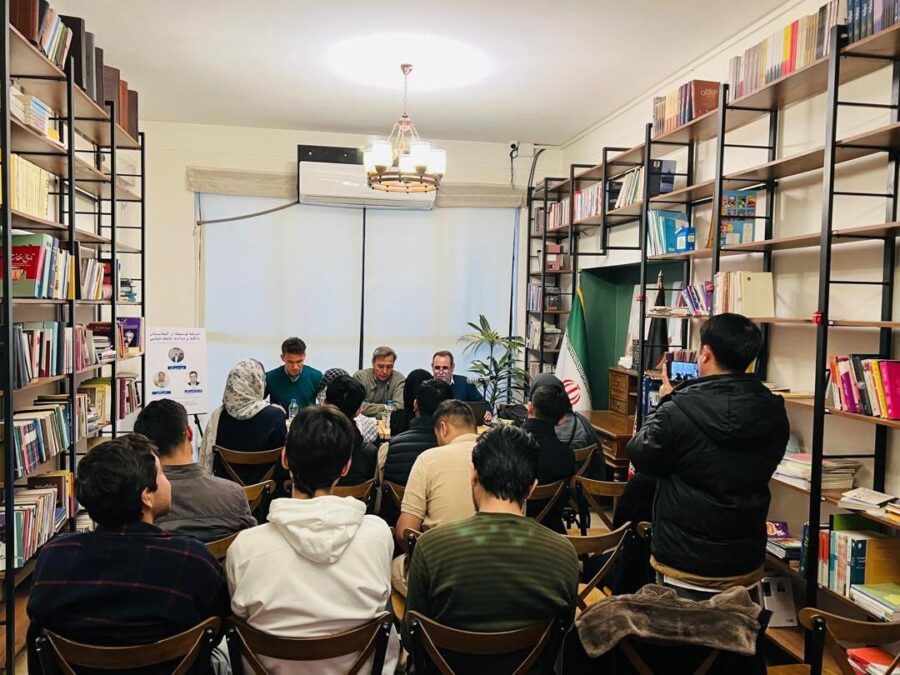
Tehran- IRAF- the session, held on Tuesday, February 17, at the Balkh Cultural Complex in Tehran, began with an explanation of the theoretical framework based on Walter Benjamin’s “constellation” method—an approach that views historical phenomena not as a linear chain of cause and effect, but as stars within a constellation.
From this perspective, geographical determinism, a long history of violence, collective trauma, institutional weakness, and diasporic divisions do not individually explain Afghanistan’s condition; however, together they form a meaningful picture of the country’s present reality.
Geography: The First Piece of the Underdevelopment Puzzle
Dr. Karami, referring to Friedrich Ratzel’s tradition of geographical determinism, stated:
“Impassable mountains, the lack of flat land, absence of access to the sea, and population dispersion across valleys have significantly increased the cost of state-building and creating a national market in Afghanistan.”
He emphasized that Afghanistan’s natural environment creates “structural constraints,” but these constraints alone do not determine the fate of development.
Critiquing Geographical Determinism: The Role of Institutions and Technology
The session also highlighted contemporary critiques in political geography, arguing that the natural environment is a “condition,” not a “destiny.”
Examples of developed mountainous countries demonstrate that effective institutions, technological advancement, and smart policymaking can mitigate natural limitations.
In this framework, geography is only one factor in Afghanistan’s development constellation—not an absolute determinant.
The Interplay of Geography, Violence, and Collective Psychology
Another segment examined the link between geography and social psychology.
According to Karami, subsistence economies, competition over scarce resources, harsh winters, and decades of war have reinforced a “security-oriented mindset” and a survival culture in Afghanistan.
He added: “Mountains are not just physical barriers; they obstruct horizontal communication among groups, and this has delayed the formation of a cohesive national identity.”
Afghanistan in Development Traps
The speakers identified four major development traps facing Afghanistan:
– Raw material dependency
– Political instability
– Weak governance
– Being caught between conflict-prone neighbors
They argued that these factors, combined with natural constraints and historical trauma, have made the path to development particularly difficult.
Urbanization Challenges in Afghanistan
Dr. Hassan Alami, focusing on urban planning, explained that Afghanistan’s mountainous terrain has forced cities to be built on slopes of 8 to 15 degrees, dramatically increasing the cost of infrastructure such as sewage systems, electricity, and water supply.
He stressed: “Afghanistan’s development is impossible without creating sustainable communication networks, tunnels, roads, and railway lines. Connectivity among ethnic groups and regions can only be strengthened through modern infrastructure.”
In concluding remarks, participants emphasized that while Afghanistan’s harsh natural environment has raised the cost of development, it is not the ultimate determining factor.