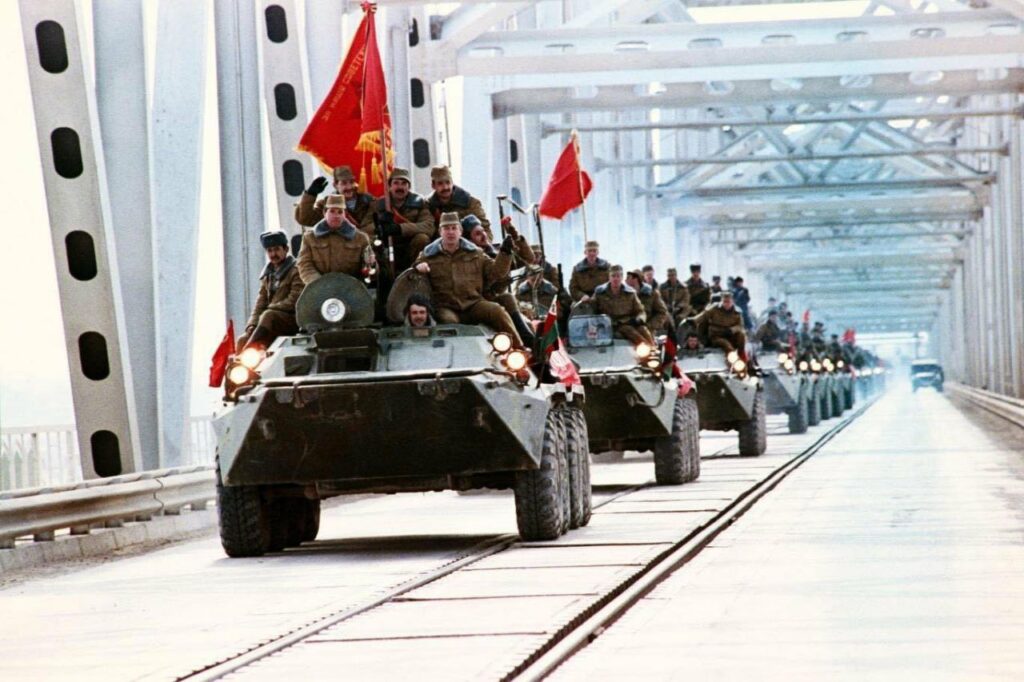
Tehran-IRAF-On this day the last column of Red Army forces, commanded by General Boris Gromov, crossed the Hairatan Bridge and permanently left Afghan territory, ending a military presence that had lasted nearly a decade, from 1979 to 1989.
The Afghanistan–Soviet War
The Soviet military invasion of Afghanistan began on December 27, 1979 with the entry of Red Army forces and the assassination of Hafizullah Amin.
This intervention was carried out in support of the then-government led by the People’s Democratic Party of Afghanistan (PDPA), triggering a widespread war between Soviet forces and the Afghan government on one side and Afghan mujahedeen on the other. The conflict left profound political, social, and economic consequences for Afghanistan and the broader region.
At the international level, the war became one of the principal arenas of Cold War rivalry between the Soviet Union and the United States. At the time, the United States and the Soviet Union, as the two superpowers of East and West, were competing to expand their influence across various countries.
Ultimately, following the signing of the Geneva Accords in 1988 between Afghanistan and Pakistan—with the United States and the Soviet Union serving as guarantors—the process of Soviet troop withdrawal began and was completed on February 15, 1989.
The Significance of 26 Bahman in Contemporary History
26 Bahman symbolizes not only the end of the Soviet military presence in Afghanistan but also what many consider the defeat of a superpower by popular resistance.
Many analysts regard the Soviet defeat in Afghanistan as one of the factors that weakened the structural foundations of the Soviet Union and contributed to its eventual collapse in 1991.
In Afghanistan’s political discourse, this day is also referred to as the “Day of Victory of Jihad” and is commemorated annually by various political and former jihadist groups.
However, some observers argue that although the Soviet withdrawal represented a military victory for the mujahedeen, the lack of a political settlement afterward plunged the country into a new phase of internal conflict.
While the Afghan mujahedeen succeeded in defeating the heavily armed Soviet Army—one of the superpowers of the time—subsequent struggles over power-sharing and continued foreign interference led to a devastating and prolonged civil war within Afghanistan.
Despite years of fighting the Soviet Union across different regions of the country, the mujahideen were unable to manage a peaceful transition of power following the withdrawal. As a result, Afghanistan descended into civil war, which caused extensive human and financial losses and laid the groundwork for the emergence of extremist groups.
Domestic and Regional Repercussions
The withdrawal of Soviet forces temporarily altered the balance of power in Afghanistan; however, the government led by Dr. Najibullah remained in power until 1992.
After the fall of Najibullah’s government, internal fighting among mujahedeen factions intensified, paving the way for subsequent developments, including the rise of the Taliban in the mid-1990s.
At the regional and global levels, the Soviet withdrawal is recorded as one of the most significant military defeats of the Soviet Union outside its borders, often compared to the Vietnam War for the United States.
26 Bahman remains a historic Wednesday in the collective memory of the Afghan people, a day that marked the end of a foreign army’s presence, yet simultaneously signaled the beginning of a new chapter of complex political and security transformations.
Now, more than three decades later, the day continues to be commemorated as a symbol of resistance, the pursuit of independence, and one of the most defining moments in Afghanistan’s contemporary history