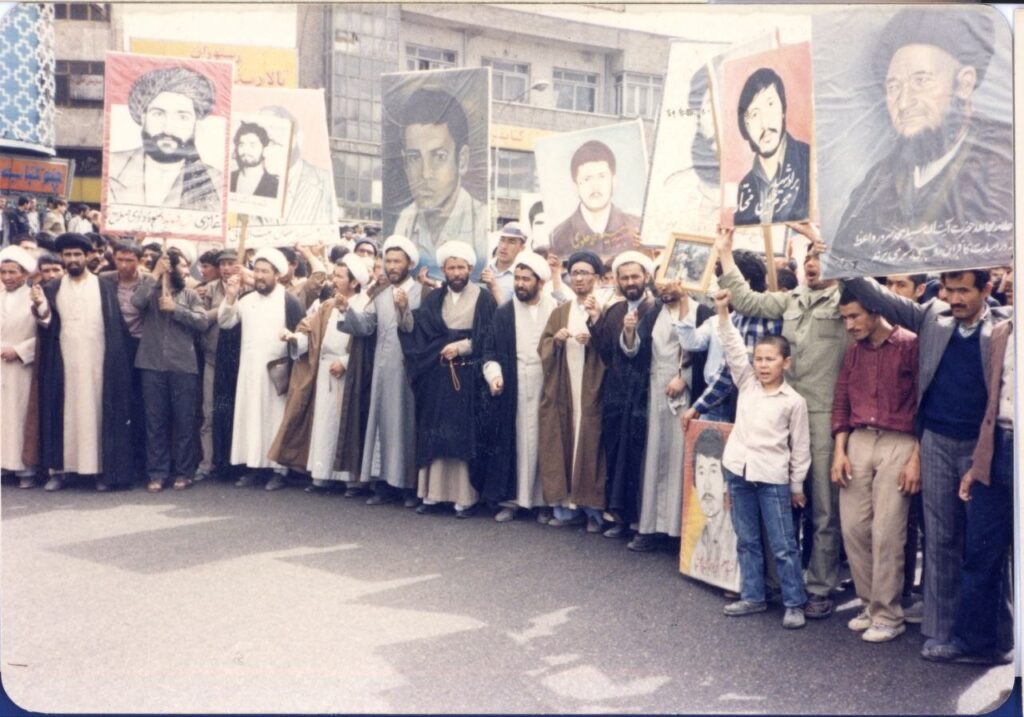
Tehran-IRAF- years before the victory of the Islamic Revolution, groups of Afghans—particularly Shiites—had migrated to Iran for various reasons, including political pressure, religious discrimination, massacres, and severe economic hardship.
These migrants settled in various cities across Iran, especially in religious centers and working‑class areas. Gradually, they became familiar with the atmosphere of struggle, protest, and Islamic awakening, and they viewed the messages of Imam Khomeini not merely as the call of a national revolution, but as a cry for the revival of Islamic dignity and the restoration of the honor of the oppressed.
Revolutionary clerics who had become acquainted with Imam Khomeini’s path in Najaf al‑Ashraf later assumed leadership of the intellectual and cultural circles within the migrant community in Iran and joined the surging tide of the Islamic Revolution. Figures such as Martyr Abdul Ali Mazari, Martyr Seyyed Hossein Hosseini, the late Farghani, and Martyr Seyyed Abdul Hamid Sajjadi were among those who fought to the very end of their lives in the path of the Imam and the course of the Islamic Revolution.
With the intensification of the Islamic movement in the 1970s, Afghan migrants also entered the revolutionary arena alongside the Iranian people. They participated in demonstrations and public rallies, played an active role in reproducing and distributing Imam Khomeini’s statements and leaflets, and engaged in raising awareness and explaining the objectives of the revolution in mosques, religious gatherings, and migrant communities.
It should be noted that in the years leading up to the victory of the revolution, there was no distinction between migrant and Iranian; anyone who loved Khomeini and the lofty ideals of the revolution was considered a member of the Islamic Revolution.
Revolutionary clerics, migrant shopkeepers, and workers—like other revolutionary groups—were organized and structured. For example, in the city of Mashhad, the migrant‑populated neighborhood of Golshahr was recognized as one of the revolutionary hubs of Afghan migrants. This underprivileged and oppressed area, relying on workers’ modest savings, established the Resalat Library, which became a center for the cultural and revolutionary activities of the migrant community.
These activities were not without danger for people who themselves lived under unstable legal and economic conditions. However, faith in the legitimacy of the Islamic movement and a deep ideological bond with the leadership of the revolution compelled them to remain actively engaged.
Many young Afghan seminarians who were deeply devoted to Imam Khomeini were not spared the hardships of the revolutionary struggle. Participation in demonstrations and revolutionary gatherings, as well as the distribution of Imam Khomeini’s books and leaflets, led many of these clerics to be detained by SAVAK and the police.
In part of his memoirs, Martyr Mohammad‑Ali Rajaei, recalling the tortures of SAVAK prisons, refers to Abdul Ali Mazari, the Afghan revolutionary, who endured the harshest forms of torture yet remained steadfast and silent, refusing to betray the path and ideals of the revolution.
In SAVAK prisons, Afghan revolutionaries were subjected to more severe torture than others, and the reason was clear: in addition to being revolutionaries, they were foreigners. For SAVAK, it was intolerable that individuals of other nationalities were standing alongside the Iranian people and taking part in the revolution.
In this context, Afghan seminarians and clerics studying in the religious seminaries of Qom and Mashhad played a particularly significant role. Drawing upon Islamic teachings and Imam Khomeini’s political thought, they became a vital link between Iran’s Islamic movement and the migrant community, transmitting the message of the revolution beyond national borders.
This intellectual current later laid the groundwork for parts of Afghanistan’s religious and political transformations to be influenced by Iran’s Islamic Revolution.
After the victory of the Islamic Revolution in February 1979, this solidarity did not come to an end. Afghan migrants continued to play an active role in consolidating the revolutionary atmosphere, engaging in cultural and religious activities, and explaining the achievements of the revolution within the migrant community. They viewed the Islamic Revolution as a living example of faith triumphing over tyranny.
In the early years following the revolution, those same young seminarians who had aligned themselves with Imam Khomeini in Najaf became the first ambassadors of the revolution in Afghanistan. As pioneers of the revolutionary movement, they carried the message of Imam Khomeini—the victory of the oppressed over the oppressors—to Afghanistan and laid the foundations for resistance against Soviet‑backed communism.
Drawing on the experiences of Iran’s Islamic Revolution, Afghan seminarians and activists initiated the discourse of exporting the revolution in Afghanistan and took steps toward expanding the revolutionary school of thought of the Imam. For them, the Iranian Revolution proved that religion could serve as the axis of popular uprising and a driving force for changing the destiny of nations.
More than anything else, what strengthened the revolutionary spirit in Afghanistan was the Imam’s clear and explicit message calling for an end to colonial domination and the establishment of an Islamic government based on justice and human dignity.
The people of Afghanistan, who had endured years of tyrannical rule and tasted the bitterness of colonialism and despotism, embraced the message of the Islamic Revolution wholeheartedly and spared no effort in striving to realize its ideals.
For those revolutionaries who learned the lessons of struggle in the school of Ruhollah, political borders hold no meaning. Whether in Afghanistan, Iran, or anywhere else in the world, they stand alongside the oppressed.
Throughout the years of the revolution and afterward, Afghan migrants stood shoulder to shoulder with the Iranian nation through all bitter and sweet events, offering numerous martyrs. The blood of Afghan martyrs shed during the Islamic Revolution, the eight‑year Sacred Defense, and the defense of holy shrines stands as a testament to the shared sacrifice of the two nations.
The presence and activities of Afghan migrants in Iran’s Islamic Revolution and beyond constitute a part of the shared history of the two peoples—a sincere and unassuming presence that has received little attention.
Revisiting this narrative is not only an act of recognition of the forgotten role of migrants in the Islamic Revolution, but also a reminder of the deep religious and historical bonds between the Iranian nation and the people of Afghanistan—bonds that were forged in the turbulent days of the revolution, in the streets, mosques, and hearts of the faithful, and that have endured ever since.