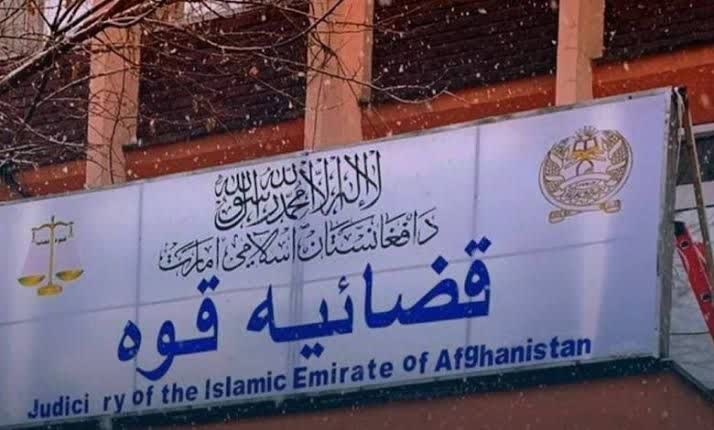
Tehran- IRAF- The website of the human rights organization “Rawadari” recently published a document titled “Criminal Code of Afghan Courts,” which was signed by Habatullah Akhundzadeh, the leader of the Taliban, and is binding for all Afghan citizens.
Based on this document, Afghan courts must consider this code as the basis for judgment and issue verdicts accordingly.
The 119-article Taliban code includes cases such as criminalizing opponents of the Taliban, slavery, and social classification in the event of committing a crime.
Abdol Rahim Rashid, spokesperson for the Taliban’s Supreme Court, confirmed the authenticity of the criminal code and stated that Afghan citizens, if they commit a crime, will be punished differently based on their social class.
What do the opponents of the Taliban say?
The publication of the Taliban’s criminal code has sparked strong and widespread reactions from various individuals, institutions, and civil society organizations.
Rahmatullah Nabil, former head of Afghanistan’s National Security, criticized the Taliban’s judicial code, stating: “The experience of many nations has shown that religion remains respected only when it is not used as a tool for political power.”
Nabil added: “Politicizing religion and adopting forceful and instrumental interpretations will not build a future for the country. The time has ended for extremism in the past and must be allow religion from the captivity of harsh and politicized interpretations.”
He emphasized: “All political currents, intellectual elites, youth, free thinkers, moderate religious scholars, women, and men of Afghanistan are faced with a historical responsibility, and the country’s future depends on creating a new narrative.”
Addressing political forces, civil society, academics, scholars, and youth, Rahmatollah Nabil stressed:
“We must all mobilize to build a citizen-centered, just, and humane Afghanistan; otherwise, the country will be trapped in an endless cycle of bitter ignorance, extremism, and violence.”
Revival of Slavery in the 21st Century
On the other hand, Ali Meysam Nazari, the foreign relations chief of the National Resistance Front of Afghanistan, wrote: “It’s nauseating to see the Taliban’s penal code, which revives institutions like slavery in the 21st century.”
He continued, pointing to the unfavorable situation in Afghanistan: “The Taliban group has removed women from public life, imprisoned thousands of young people for political reasons, and turned Afghanistan into a hub for regional and global terrorism. The fate of over 40 million people has been handed over to the hands of illiterate mullahs from a tribe in a country where all ethnic groups are in the minority. The Taliban’s rule of terror and tyranny is getting worse by the day.”
The Taliban’s code is based on Hanafi jurisprudence, and according to this document, followers of other religions and sects are labeled as “innovators.” Meanwhile, there are over ten different ethnic groups and Islamic sects in Afghanistan.
Scandalous and Frivolous
Fazl Ahmad Ma’nawi, the former Minister of Justice of Afghanistan, considered this code scandalous and stated: “The Taliban’s code brings Islam, Sharia, and Afghanistan to ridicule and scorn in the eyes of the global public.”
The Islamic Jamiat Party of Afghanistan also issued a statement condemning the Taliban’s code, labeling it as a “document of deviation” and writing: “The Taliban’s deviation document, by institutionalizing discrimination and impunity, is in conflict with justice and Sharia. Afghan religious scholars must take a correct and explicit stance to prevent the Taliban’s instrumental use of religion.”
The party added that the Taliban, by implementing this code, seeks to institutionalize systematic discrimination and tyranny in the country.
Closed and Tribal Authoritarianism
Fuzieh Koofi, a women’s rights activist and former Afghan parliamentarian, also commented on this code: “The Taliban seeks to establish closed and tribal authoritarianism.” She warned about the implementation of this code and the fate of Afghan women.
Women’s rights activists consider this code to be against international standards and a violation of women’s rights.
Suppression and Denial of Human Dignity
The “Jebheye Azadi-e Afghanistan” (Afghanistan Freedom Front) also considered the Taliban’s code an obvious attempt to institutionalize discrimination and suppression, leading to the denial of human dignity and suppression of people. The front condemned this code.
Deliberate Effort to Distort Islam’s Image
The High Council of National Resistance for the Salvation of Afghanistan also reacted to this code. The council believes that the Taliban’s code returns Afghanistan to the Middle Ages. In its statement, the council stated that the Taliban’s attempt to implement this code is a deliberate effort to distort Islam’s image in the eyes of the global public.
The Women’s Movement for Peace and Freedom condemned this code, stating: “The Taliban’s penal code will legalize and institutionalize violence in Afghanistan.” The movement called on the Afghan people not to allow the Taliban to normalize their actions under any name and turn them into law.
Concerning Consequences
In response to the Taliban’s penal code, Richard Bennett, the UN Special Rapporteur on Human Rights, expressed concern about its implementation, stating that he will examine it from the perspective of human rights and Sharia.
He wrote on his X page: “The consequences of this code for the people of Afghanistan are very concerning.” Bennett promised to issue a detailed statement on this document at the appropriate time.
The Taliban’s judicial code is, in fact, executive instructions for judges, compiled based on the Hanafi Sunni sect and the Taliban’s specific tendencies. According to this code, opponents of the Taliban are labeled as “baghi” (rebels), and a death sentence is issued against them.
Some analysts believe that the Taliban have ignored the rights of other sects and minorities by doing so.