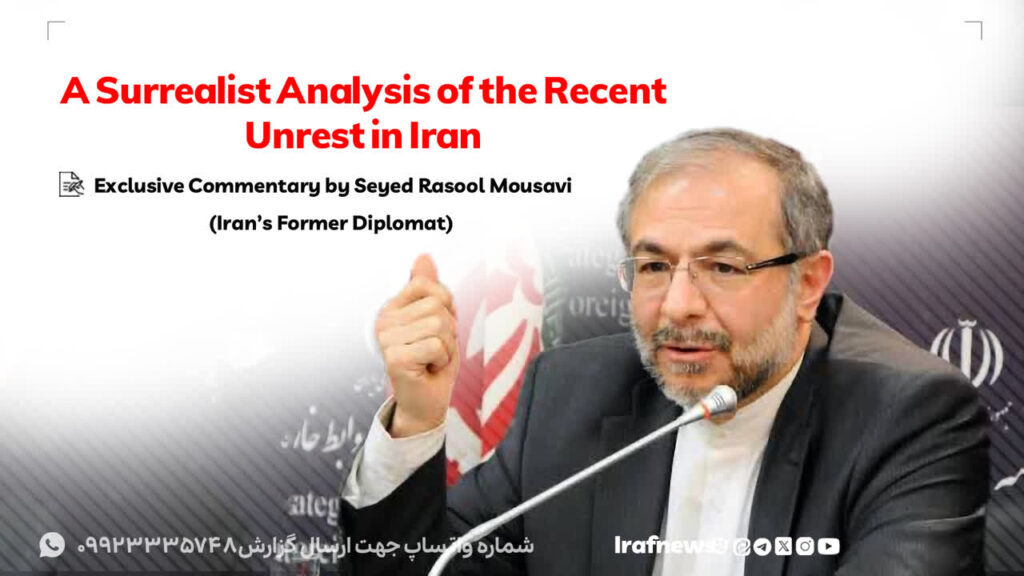
Tehran- IRAF- The events of January 7 and 8 in our beloved country are significant from multiple perspectives and provide numerous lessons. One of these dimensions is the scale of destruction and depth of crimes, to the extent that even the perpetrators themselves avoid acknowledging responsibility for these actions, refusing to admit that the crimes were committed by their affiliates.
If we liken the events to a theatrical performance, it can be said that the “play” unfolded in three acts:
Act One: Peaceful public protests regarding the country’s economic conditions, aimed at sending a message to the government and authorities that the economic situation is dire, the markets face serious problems, and unless urgent and decisive action is taken, matters will unravel.
The message was so clear that it was acknowledged at the highest level of the system. The Supreme Leader noted:
“The merchants’ protests against the decline in national currency, which destabilizes the business environment, are valid. Honest businessmen say they cannot conduct business under these conditions; officials agree, and the President and senior authorities are seeking solutions. However, enemies are also involved in this problem, and the instability and uncontrolled rise in foreign currency prices, which confuses merchants, must be addressed through various measures, which authorities are actively pursuing.”
The peaceful protests were carried out in broad daylight, with appropriate media coverage, and no security disorder occurred, as security forces themselves safeguarded the protesters.
Act Two: Anti-security calls to confront political and security institutions by various anti-republican groups—including monarchists, the Mojahedin, PJAK, Komala, Jaysh al-Zolm, Ansar al-Sheytan, and others—through nighttime gatherings.
The shift from daytime protests to nighttime gatherings serves as a key indicator distinguishing popular protests from riotous assemblies, creating a context for terrorists to infiltrate the demonstrations.
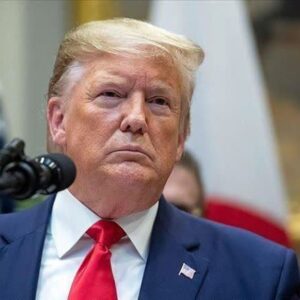
The most significant event of Act Two, unprecedented in world politics, was the overt entry of former U.S. President Donald Trump into the scene, supporting rioters and terrorists.
Act Three: The mass public uprising on January 12 (22 Day)), which broke the spell of Act Two—the coalition of rioters and terrorists. Adversarial media may claim otherwise, but participants in the January 12 (22 Day), demonstrations know that such a dense, massive crowd had not been seen in post-revolution years, reminiscent of the early years of the revolution.
The events can be analyzed from multiple perspectives, but one question remains: Has the play ended, or are there more acts?
Realists, considering the U.S. fleet’s movements to the Gulf of Oman and the Persian Gulf, argue that the U.S. would not deploy forces in the region without intending to act. However, they fail to account for the timeline: when Act Two actors entered the scene, the U.S. fleet was engaged in Venezuela, and Israel was busy repairing its Iron Dome.
Rioters and terrorists attempted to exploit the public protests, expecting to control the streets until the U.S. fleet arrived. They did not realize that there was a third act: the millions of people on January 12. Dey.
Western media can say whatever they want; the people present on January 12 (22 Day) demonstrations witnessed a turnout unseen for decades.
Surrealists, unlike realists, argue that in Iran-related events, one should not focus solely on material power or view U.S. hard power as the decisive factor. Rather, multiple non-material factors intervene in shaping outcomes, often resulting in a final result opposite to early predictions.
Surrealists believe that the U.S. fleet approaching Iran is more defensive than offensive, while moving away from Iranian waters and missile range could signal readiness for an attack, not approach. Drawing on the experience of the USS Harry Truman’s confrontation with Yemeni fighters—where the carrier was humiliated by Yemeni missiles—they argue that such ships are vulnerable to Iranian missile capabilities.
The Truman incident was so blatant that an Israeli critic of Netanyahu remarked: “Hoping for the U.S. to enter a war with Iran is like hoping for it in Yemen—it gave up halfway and settled a ceasefire with Ansar Allah.”
This does not mean U.S. forces cannot inflict heavy costs on Iran’s military and economic structures, but the Air Force and Navy, despite being among the strongest in the world, cannot determine the fate of nations committed to resisting U.S. imperialism.
Iran is not Venezuela, Syria, Libya, Iraq, or Afghanistan. Iran’s hard, soft, and popular power are so intertwined that the U.S. is forced to consider the endgame more than the start of a conflict.
The U.S. today is not the same as during the Cold War or the invasions of Afghanistan and Iraq. Despite media bravado, the U.S. military lacks the will and readiness for a prolonged, large-scale regional war, and neither do its Western and regional allies.
In a surrealist analysis, any plan for a U.S. military invasion of Iran is obsolete and ineffective.
This attack, initially intended to coincide with urban chaos and Mossad/CIA-assisted city takeovers, was prevented due to the failure of street riots, inability to meet objectives, severe setbacks to organized terrorist cells, and U.S. apprehension about consequences. Future attempts would be far more costly, complex, and consequential.
In surrealist terms, the preemptive public demonstrations of Act One misled the actors of Act Two, trapping them in a situation without support, abandoned by the U.S. and Israel, and leaving Act Three—the people—to conclude the story.
Even now, U.S. power displays cannot reverse the course. Its “fifth column” has been neutralized, Iranian hard power watches with fingers on the trigger, and the Iranian people do not believe in Trump’s mirage.
Final Words:
Realists argue that U.S. hard power determines the final outcome. Surrealists assert that the ending narrative is not with the U.S., but with those who hold the belief “And you did not throw when you threw, but Allah threw…” (Surah Al-Anfal, Verse 17)