According to IRAF News Agency, Local sources report that the Taliban have arrested dozens of Shia residents in the Afshar Darul Aman neighborhood of Kabul following protests against an order to prevent burials at a local cemetery.
During the incident, at least 38 to 45 protesters, including the Imam’s local mosque, and the neighborhood’s Wazir-e-Guzar (local official), were detained by agents from the Taliban’s Ministry of Justice and moved to an unidentified location. The situation and location of those detained remain unknown days later.
Following the arrests, local residents obtained a document from the Ministry of Hajj and Religious Affairs of the former government, showing that the disputed cemetery was officially registered as belonging to the people of Afshar Darul Aman.
Despite this document, the Taliban’s Minister of Justice claims that the cemetery does not belong to people, considers burial there as a crime and refuses to release the detainees.
Exhume the body!
The incident began when on Wednesday, December 10, local residents buried the body of one of their community members in a cemetery located near the Ministry of Justice.
Following the burial, officials from the Ministry of Justice demanded that residents exhume the body and transfer it to another location.
The request was met with strong opposition from local residents, triggering protests and demonstrations along Darul Aman Road.
The Taliban’s Ministry of Justice had previously warned residents against burying the deceased in the cemetery, claimed the location as a designated “green zone”.
However, local residents emphasize that the cemetery has served for several decades—and even generations as the burial ground for Shiite residents of Afshar Darul Aman, and that they have now been asked to relocate the remains of bodies already buried there to another location.
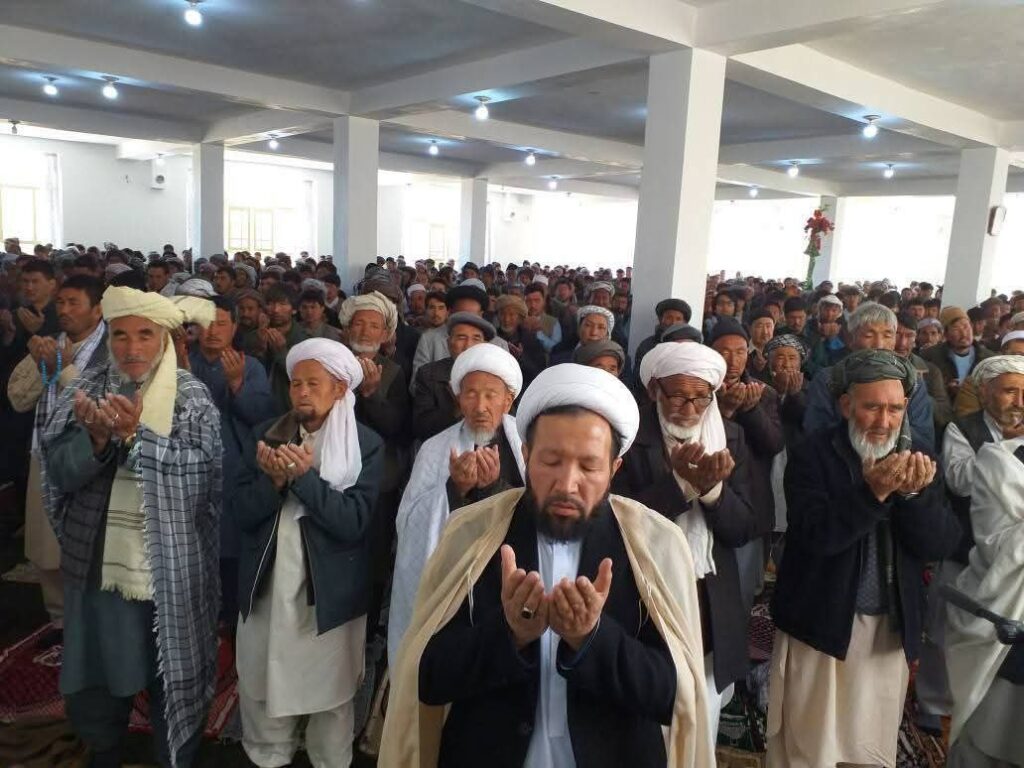
Local sources say that during the protests, Taliban forces intervened extensively and detained dozens of demonstrators, most of whom are from the Qizilbash ethnic group and followers of the Shiite religious.
Families of those detained say that several days after the arrests, they have received no information about their relatives’ health conditions, place of detention, or the legal process being pursued in their cases, and that they have not been allowed to visit them.
Residents of Darul Aman also claim that the Taliban’s Ministry of Justice has declared the land of the local mosque to be “state-owned,” despite their assertion that the land was donated by a local resident and is backed by a valid religious title deed. They say this move is part of continued pressure.
As part of this ongoing trend, the Taliban yesterday shut down the Imam Hussein (PBUH) Cultural Complex, one of the active cultural centers in western Kabul. It is reported that the order to close the center was issued by Abdul Hakim Shar’i, the Taliban’s Minister of Justice.
The Sayed Jafar’s shrine, one of Kabul’s long-standing pilgrimage sites, was also demolished on the direct order of Abdul Hakim Shar’i.
Regarding this issue, Abdul Hakim Shar’i said, he holds no hostility toward Shiites and that the measures were taken in line with the policies of the Ministry of Justice.
He further stated that any entity violating the Emirate’s orders would first receive a warning before having its operating license revoked.
A Shi’a-Majority Area with a History Spanning Centuries
Afshar Darul Aman is among the oldest Shiite-inhabited areas of Kabul, located in the southwest of the city. Historically, Qizilbash, Afshar, and Bayat communities have lived in the area, which is home to numerous historical sites, residences, and cemeteries.
Local elders say that having a cemetery is among the most fundamental civil rights of any community, and they view the Taliban’s actions on this matter as discriminatory and rooted in religious bias.
According to residents, Sunni followers in the same area have active cemeteries and have not faced such restrictions or treatment.
They emphasize that if cemetery lands are considered “state-owned,” the rule should be applied uniformly to all, not exclusively to Shiite cemeteries.
The people of Afshar Darul Aman have called on media outlets and human rights organizations to pay attention to the situation of those detained and to prevent the destruction of their cemeteries and religious sites, stressing that their sole demands are justice, respect for their historical rights, and the release of those arrested.