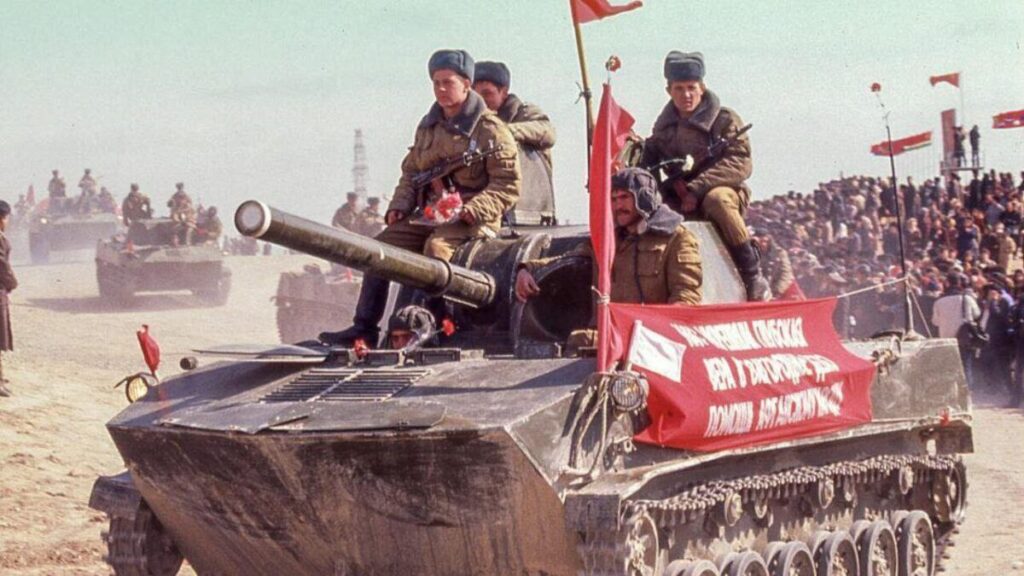
According to IRAF News Agency, The Soviet–Afghan War (1979–1989) was one of the most significant conflicts of the late twentieth century and the final confrontation of the Cold War era. This military intervention was accelerated by a preceding set of events in Kabul, rooted in the crises of Afghanistan’s domestic politics.
In this context, some observers believe that the occupation of Afghanistan by the Soviet Union in 1979 cannot be viewed as a simple, classic military invasion. This event resulted from the confluence of three main factors: the deep internal crisis within Afghanistan, the logic of great power rivalry during the Cold War, and the direct and indirect interventions of the United States of America.
Some analysts also point to two important patterns in this intervention: first, the Soviet Union’s unpreparedness for a protracted war, and second, the improvisational nature and weak planning behind the decision to attack. This occurred while numerous Afghan Mujahideen groups surprised the Red Army by receiving military equipment and technical support from the CIA. According to some analysts, the Soviet military engagement in Afghanistan took on a static nature: the Red Army controlled the cities, district centers, and transportation infrastructure, while the Mujahideen maintained control over rural areas and the outskirts of cities.
The Internal Crisis in Afghanistan: A Neglected Context
Following the coup of April 1978, and the ascendancy of the People’s Democratic Party of Afghanistan (PDPA), the new regime attempted to implement sweeping ideological and social reforms with high speed and violence. These reforms were not only incompatible with Afghanistan’s traditional social structure but also exacerbated ethnic, religious, and tribal divisions. Consequently, the Kabul government became severely unstable and increasingly dependent on foreign support for its survival.
Soviet Calculations: Fear of an Ally’s Collapse
From the perspective of Soviet leaders, Afghanistan was not merely a neighboring country; it was considered part of the Soviet Union’s southern security belt. The instability in Kabul and the possibility of a friendly government collapsing created the fear that Afghanistan could fall into the sphere of influence of the United States. From this viewpoint, the Soviet military intervention was perceived less as an attempt to expand communism and more as a measure to prevent the destruction of existing influence—an action whose consequences were severely underestimated, ultimately leading to a protracted war.
In other words, Afghanistan’s internal chaos primarily worried the Soviet leadership because this situation increased the likelihood of Afghan leaders aligning with the United States to seek assistance. According to reports, senior members of the Communist Party of the Soviet Union warned Leonid Brezhnev in late October 1979 that Hafizullah Amin was pursuing a more balanced policy and that the United States could recognize this shift. Only a few weeks later, Yuri Andropov, the KGB Chief, along with Andrei Gromyko, the Foreign Minister, and Dmitri Ustinov, the Soviet Minister of Defense, sounded the alarm. They convinced Brezhnev that even if the US was not actively seeking to undermine Soviet influence in Afghanistan, Amin’s regime, by creating vulnerabilities, would hand future opportunities for exploitation to Washington. Therefore, they argued that Moscow had to intervene.
Thus, the existence of a shaky but ostensibly friendly regime provided the opportunity for the Soviet Union to resort to military intervention, invoking the Brezhnev Doctrine. However, many observers believe that the invasion of Afghanistan to prop up an unpopular regime was a misguided and doomed endeavor. Nevertheless, for the Soviet leaders in the cold days of the winter of 1979, such a decision seemed logical and unavoidable.
The Role of the U.S.: Indirect but Decisive Intervention
From the American perspective, Afghanistan was considered a country of limited importance for most of the twentieth century. As reports from the U.S. Embassy noted mid-century, “Afghanistan currently has limited direct interests.” Even in the late 1970s, as Soviet influence grew and leftist movements gained power in Afghanistan, the United States did not show a serious reaction to the country’s internal developments.
However, the expansion of Soviet influence in Afghanistan, coupled with America’s defeat in the Vietnam War, paved the way for a shift in Washington’s approach. This time, the United States engaged in the jihad against the Soviet occupation not directly, but through indirect intervention. Seeking to contain Soviet influence after Vietnam, the U.S. viewed Afghanistan as a strategic opportunity. Historical evidence indicates that Washington began supporting the opponents of the Kabul regime even before the official entry of the Soviet army.
The role of the CIA in equipping and organizing a number of Mujahideen groups was part of a conscious strategy to bog down the Soviets in a costly war—a strategy later referred to as the “Soviet Vietnam.” According to some reports, the United States channeled weapons and financial resources to certain Mujahideen factions through Pakistan. These supports, known as “Operation Cyclone,” peaked during Ronald Reagan’s presidency, with U.S. aid increasing to about $400 million annually. The consequences of this support would plague the security of Afghanistan, the region, and even the international system years later; some observers suggest that Osama bin Laden, the leader of Al-Qaeda and mastermind of the 9/11 attacks, benefited from training and indirect support from the U.S. as part of the Afghan-Arab network formed during this war.
In this context, Afghanistan effectively became a field for geopolitical competition. Both the Soviet Union, striving to preserve its influence, and the U.S., aiming to weaken its rival, bypassed the social and human realities of Afghanistan. The result of this confrontation was widespread destruction, the displacement of millions, and the deep militarization of society—consequences whose effects continued for decades.
American Victory or Shared Defeat?
Although the Soviet withdrawal from Afghanistan is often interpreted as the superpower’s defeat and a strategic victory for the United States, this “victory” was short-lived. The U.S. support for Islamist armed groups, without a clear plan for Afghanistan’s political future, laid the groundwork for subsequent instability and global security threats. From this perspective, the invasion of Afghanistan symbolized not only the Soviet failure but also the moral and political failure of both superpowers in managing crises in the Third World.
In summary, the occupation of Afghanistan in 1979, must be seen as the result of a chain of mistaken decisions, ideological rivalries, and foreign interventions. The Soviet Union became mired in a war from which withdrawal carried heavy costs, while the U.S., achieving a tactical victory, sowed the seeds for longer-term crises. Ultimately, the primary loser of this confrontation was the people of Afghanistan, who paid the price for the great power competition through generations of suffering.