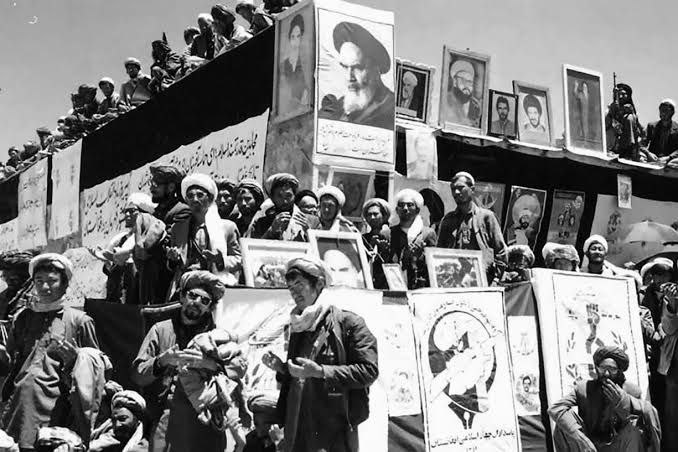
Tehran- IRAF- The Shia Muslims of Afghanistan, who are mostly of the Hazara ethnicity, established a deep and fundamental relationship with Imam Khomeini. They were drawn to his anti-oppression, anti-tyranny, and anti-colonial thoughts and ideas more than others, due to the historical persecutions they endured because of their devotion to the Ahl al-Bayt (AS).
Given the scope of the representatives’ networks and the regions covered by each, it is clear that Imam Khomeini paid special attention to the Shias of Afghanistan and effectively guided the community’s intellectual and ideological development through his delegates.
The representatives of Imam Khomeini in Afghanistan, besides answering religious questions and carrying out assigned duties, were responsible for enlightening the public and disseminating the Imam’s views and ideas. Naturally, performing such a task during the era when Afghanistan was ruled by the Taghut (non-Islamic regimes) was not simple and brought severe consequences and dangers for the representatives.
Most of the Imam’s representatives in Afghanistan have records of imprisonment, torture, and exile, testifying to the suffering of being a “Khomeinist.”
During the Communist regime in Afghanistan, when Shias faced harassment and the holding of religious ceremonies like Ashura was banned, it was these representatives of the Imam who invited the people toward revolution and struggle. As a result, the Communist rulers suppressed many of the Imam’s representatives and even his followers, labeling them “Khomeinists,” with punishments such as imprisonment, torture, and even execution.
In the list of the five thousand martyrs of Afghanistan who were massacred during the Communist rule, only one charge is written next to many of the names: Khomeinist.
Imam Khomeini’s Representatives in Afghanistan
Over the decades of Imam Khomeini’s Marja’iyya (religious authority), dozens of Afghan Shia scholars received authorization documents (Vekalat-nameh) from him. However, the exact number of the Imam’s Afghan representatives is unknown.
Nevertheless, a number of the Imam’s representatives who, in addition to their delegated religious duties, assumed the role of intellectual and political leadership for the Shia community in Afghanistan, are well-known.
Martyr Abdul Ali Mazari
Martyr Abdul Ali Mazari was one of Imam Khomeini’s representatives who also had a special relationship with the Imam and the leadership of the Islamic Revolution of Iran. He was also arrested and imprisoned by SAVAK (Iran’s pre-revolution secret police) due to his revolutionary activities in Iran.
In the text of Martyr Mazari’s Ijazah-nameh (Authorization Letter), Imam Khomeini wrote:
All praise is due to God, the Lord of the Worlds, and may God bless Muhammad and his pure progeny, and may the curse of God be upon all their enemies.
Thereafter, His Eminence, Saqat- al-Islam Mr. Agha Sheikh Abdul Ali Mazari, who spent a portion of his life studying religious sciences in the holy seminary of Qom, is authorized by me to collect religious dues such as Zakat and Mazalim al-Ibad; and is also authorized to collect the blessed Share of the Imam (AS) and the Share of the great Sayyeds, and to spend them among the eligible recipients in the areas where he intends to travel and reside, which are the regions of “Mazar,” “Chaharkent,” “Dareh-e Yusuf,” “Poshtond,” and “Dahana-e Ghuri,” within the subordinate districts of Balkh, Afghanistan. It is hoped that he will exercise utmost caution in collecting and spending these funds.
I ask God Almighty for his success.
Peace be upon him and upon our faithful brothers.
Dated: 9 Sha’ban 1400 AH
Roohollah Al-Mousavi Al-Khomeini
Since the people of Afghanistan were an oppressed and tyrannical nation, Martyr Mazari became even more devoted to the Imam’s exceptional and anti-oppression personality, becoming one of the most recognized representatives of the Imam in Afghanistan.
After the victory of the Islamic Revolution, Martyr Abdul Ali Mazari returned to Afghanistan to establish the foundations of revolution and struggle there, using the experiences he had learned from the school of Imam Khomeini.
He attained martyrdom in the winter of 1995 AD, after years of struggle and effort in the path of Imam Khomeini’s school and the Islamic Revolution.
Martyr Ayatollah Sultan Mohammad Turkestani (Shahid Ayatollah Sultan Mohammad Turkestani)
Sultan Mohammad Turkestani is another representative of Imam Khomeini who, after years of study in Najaf Ashraf, eventually returned to Afghanistan and began extensive activities as the Imam’s delegate.
Ayatollah Turkestani played a significant role in expanding Shia religious studies in the northern and central regions of Afghanistan, particularly in Mazar-i-Sharif, by establishing the Soltaniyyeh Seminary and several other schools and Hossainiyyehs.
He was one of the individuals who was cruelly martyred following the coup by the Communist People’s Democratic Party (in 1978).
Ayatollah Mirhossein Sadeghi Parvani
Mirhossein Sadeghi was born in Parvan province in 1934. After elementary education, he traveled to Qom and then to Najaf to continue his studies.
Sadeghi returned to Afghanistan after 15 years of studying in Najaf and settled in Kabul. He was among the representatives whom the Imam had authorized in his Vekalat-nameh (Authorized Letter), to spend the religious dues inside Afghanistan if necessary.
Sadeghi Parvani was actively involved in forming the Hosseini Party and the Vahdat Party. After the formation of the government, he served as a Senator in the Afghan Parliament and passed away in Kabul in 2016 AD.
Ayatollah Seyyed Mohammad Hussein Husseini (Sajjadi)
Ayatollah Seyyed Mohammad Hussein Husseini (Sajjadi) was born in 1911, in the Lal va Sarjangal district into a religious family.
In his youth, he traveled to Najaf and benefited from the presence of distinguished masters such as Seyyed Mohsen Hakim, Imam Khomeini, Abul-Qasem Khoe’i, and Abul-Hassan Esfahani. He returned to his homeland after receiving authorization from the Grand Ayatollahs: Imam Khomeini, Khoe’i, Isfahani, Hakim, and Shahroudi.
Three of Ayatollah Husseini’s sons—Martyr Sayyed Abdul Hamid Sajjadi, Martyr Sayyed Shahab al-Din Husseini, and Martyr Sayyed Mohammad Amin Sajjadi, all of whom were clerics—were martyred during the years of revolution in Afghanistan.
He passed away in 1974. After him, his eldest son, Hojjat ol-Islam Seyyed Mohammad Hassan Sharifi (Sajjadi), received authorization from the Imam to continue the activities.
Ayatollah Seyyed Mohammad Hassan Ra’is Yakawlangi
Ayatollah Ra’is was born in Yakawlang, Bamiyan, in 1893. After his preliminary studies, he traveled to Najaf Ashraf for higher education.
After years of study in Najaf and receiving authorization from the Grand Ayatollahs, he returned to his homeland and began extensive activities.
Ayatollah Ra’is was one of the militant clerics who was imprisoned in Dehmazang Prison during the reign of Zaher Shah. He passed away after years of sincere service.
In addition to these five representatives, other scholars and clerics also held the representation of Imam Khomeini in various parts of Afghanistan. Some of the most prominent names include:
- Martyr Ayatollah Sayyed Ali Ahmad Alam (Shahid Ayatollah Seyyed Ali Ahmad Alam)
- Ayatollah Mohammad Hussein Sheikhzadeh Ghaznavi
- Hojjat ol-Islam Gholamreza Zaryafteh
- Ayatollah Noor Ahmad Taqadossi
- Martyr Mirhossein Sharifi (Shahid Mirhossein Sharifi)
- Martyr Seyyed Hussein Husseini Dareh Soufi (Shahid Seyyed Hussein Husseini Dareh Soufi)
- Hojjat al-Islam Seyyed Is’haq Naqavi
- Seyyed Abdul Hamid Moravej
- Mohammad Hussein Taqadossi Malestani
Most of the scholars and clerics who were authorized or delegated by the Imam were revolutionary and militant figures who played an active role in guiding the people throughout the years of the revolution and Jihad in Afghanistan.