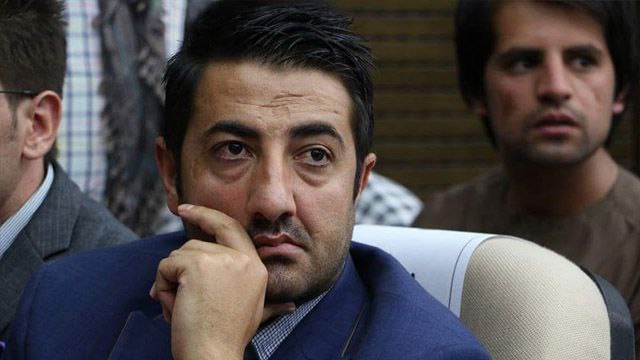
Najib Barvar, an Afghan poet, marking the anniversary commemorating Rudaki, spoke in an exclusive interview with IRAF News Agency, about the historical and cultural status of the renowned poet. He said that Rudaki is referred to as the father of Persian poetry not because he was the first Persian-language poet, but because he is the first poet known to have had a compiled divan (collection of poems) attributed to him.
Barvar added that, according to historical sources, there were other poets in different periods who composed Persian poetry. However, because Rudaki maintained continuity in the production of Persian literature and played a sustained role in its development, he can be regarded as the first official poet of the Persian language.
The Afghan poet continued by noting that due to events that occurred during the rule of the Samanids, many intellectual, cultural, and historical sources were affected or lost.
Despite being recognized as the first official poet of the Persian language, historical accounts suggest that Rudaki composed an extraordinary body of work—estimated by various sources at 60,000, 100,000, or even as many as one million verses in Persian. These included major works such as Kelileh o Demneh, which significantly expanded the scope of his poetry. Nevertheless, due to the upheavals and hardships of his time, very little of Rudaki’s literary legacy has survived, and today only a handful of his poems remain extant.
A Poet as an Adviser to the King
Referring to Rudaki’s social status, Barvar said that Rudaki was widely respected and, according to historical studies, was not only a poet but also considered one of the pillars of the Samanid administration. His counsel and advice to Samanid rulers, Barvar noted, reflect his personal virtues and elevated standing.
He added that Rudaki’s unique manner of reciting his poetry—reportedly performing his verses in a melodic form—further illustrates this status. Historical sources have cited the powerful impact of Rudaki’s words, including the well-known account of the poem “The scent of the Muliyan stream comes to mind” (Bū-ye Jū-ye Mūliyān Āyad Hamī), which is said to have so deeply affected Ahmad Nasr Samani that it prompted him to set out toward Bukhara.
The Afghan poet continued: According to historical accounts, the soldiers, frustrated by Ahmad Nasr Samani prolonged stay in Herat, approached Rudaki and asked him to persuade the king, by any means he could, to embark on the journey to Bukhara.
Barvar said: “I read that on one occasion, Ahmad Nasr Samani made a hasty decision to order someone’s execution, but later regretted it. After that, he decreed that he would not make any further decisions without consulting several senior advisors around him. At that time, scholars and thinkers were brought together, and three of them were selected for critical and sensitive counsel—this is how Rudaki’s presence among the king’s advisers began.”
He added: “The king declared that no decision would be made or implemented without the input of these three advisors. Within this trio, Rudaki held a distinguished role. This is why he was respected not only by the court but also by the general public.”
Rudaki: A Poet of Wisdom
Referring to the historical perspective on poetry, the Afghan poet said: “In ancient times, poetry and poets were regarded with deep respect, and not everyone could claim that title. Rudaki’s presence as a sage, poet, and thinker reflects his intellectual, cultural, and literary virtues.”
Barvar continued: “During the 3rd century AH in Bukhara, a movement arose to revive the Persian language and culture. In the field of poetry and literature, Rudaki was among the founders of a new kind of poetic thought. What distinguished him was not merely that he was a poet or had a divan, but the perspective and ideas he conveyed in his poetry, which were pioneering and highly influential”.
He said: “For the first time, the significance of wisdom was highlighted by Rudaki as one of the most important foundations of poetry. Later, Ferdowsi, Khayyam, and subsequently Hafez each carried forward this idea in their own way, and an intertextual continuity regarding wisdom can be observed across their works.”
The Afghan poet continued: “Rudaki revived the rationalist thought inherited from our ancient intellectual traditions in his poetry, and this very scholarly approach enhanced his spiritual stature.”
Rudaki: From Samarkand or Rudak?
Barvar spoke about Rudaki’s birthplace: “Historical sources identify Rudaki as being from Samarkand, although it is unclear whether the title ‘Rudaki’ comes from his birthplace, called ‘Rudak,’ or from his skill in playing the stringed instrument and incorporating music into his poetry.”
He added: “According to the old geographical divisions, Rudaki hailed from the vicinity of Samarkand. However, under modern borders, this region is now part of present-day Tajikistan, and even culturally, Samarkand has been divided into several parts in contemporary maps.”
The Afghan poet continued: “Just as Attar is known as a Nishapuri poet despite being born in Kadkan, Rudaki belongs to the historical geography of Samarkand, which today falls within Tajikistan.”
Barvar said: “Across different eras, Hafez, Sa’adi, Ferdowsi, and Rumi have carried the responsibility of Persian culture. A systematic study of their works is essential for every Persian speaker.”
He added: “Literature serves as the collective memory of different periods, and these rich cultural treasures have been passed down to us orally and in writing. Reading them helps us understand the nature and evolution of Persian poetry.”
Concluding his remarks, the Afghan poet emphasized: “As a cultural figure advocating for unity among Persian-speaking countries, I hope that one day this shared heritage will receive real attention, and at least a cultural union among Persian speakers will be established. The role of governments, especially Iran, in organizing and supporting this cultural initiative is highly decisive.”