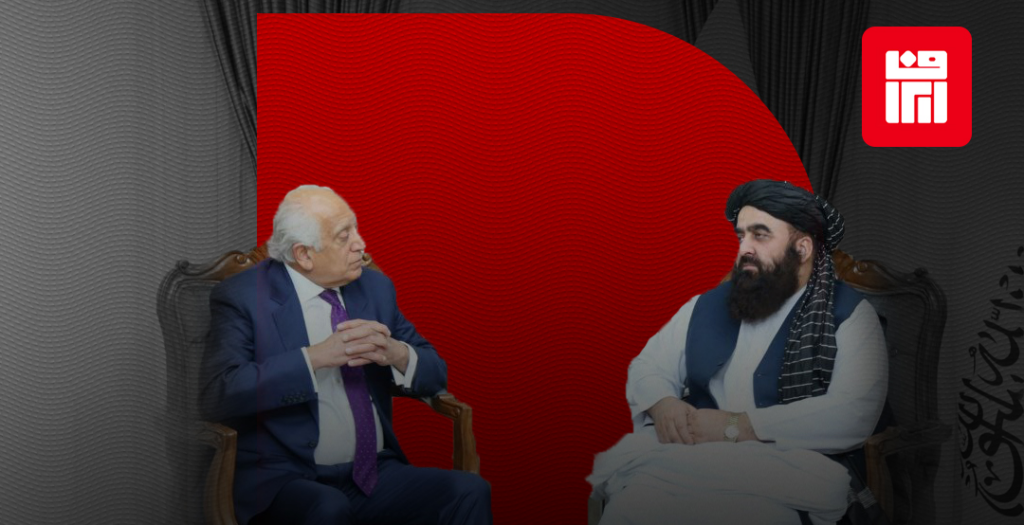
According to IRAF News Agency, Zalmay Khalilzad, the former US Special Representative for Afghan Peace, has once again traveled to Kabul in an unexpected visit. In a statement issued by the Taliban’s Ministry of Foreign Affairs, quoting Acting Foreign Minister Amir Khan Muttaqi, it was said that engagement between the Taliban and the United States has entered a “new phase.”
During the meeting, the two sides held comprehensive discussions on the “methods, opportunities, and challenges for expanding bilateral relations” between Afghanistan and the United States.
Referring to more than four years since the withdrawal of foreign forces from Afghanistan and the end of the war, Amir Khan Muttaqi said that Taliban–US engagement has moved into a new stage. Zakir Jalali, head of the third political department at the Taliban Foreign Ministry, also stated that there is no “significant complexity” in relations between the two sides and that conditions are in place for a realistic reassessment of ties.
Pointing to the Doha Agreement, Jalali described it as evidence of a “notable level of pragmatism” on both sides, adding that the agreement demonstrates that Kabul and Washington can focus on new opportunities for cooperation without becoming trapped by the past.
While the Taliban have warmly welcomed the visit, observers have described it as a continuation of Khalilzad’s longstanding efforts to support the group—efforts that have earned him the label of the “leader of the Taliban” among his critics.
Malek Satiz, an Afghan researcher and analyst, wrote in a commentary published concurrently with Khalilzad’s latest visit to Kabul that he regards Khalilzad as the “primary and contemporary leader of the Taliban.” Malek Satiz claimed that Khalilzad has played a greater role than any internal Taliban figure in consolidating the group and facilitating its return to power.
Khalilzad, long recognized as the architect of the talks that culminated in the Doha Agreement, now operates in the capacity of an unofficial envoy, backed by a broad network of connections and influence. Rather than seeking a concrete agreement, he appears focused on gauging the political environment and creating greater room for maneuver for both sides beyond the constraints of formal diplomacy.
For the Taliban, Khalilzad simultaneously represents a “familiar intermediary” and a “symbol of the past”—a symbol of the agreement that, in their view, laid the groundwork for the international legitimacy of the current governing structure.
Now, through repeated back-and-forth visits, Khalilzad appears intent on avoiding the consequences of any formal meetings that could complicate the pursuit of an agreement, instead seeking to smooth the path of relations through mediation. As noted in the Taliban Foreign Ministry’s statement, these exchanges have resulted in relations entering a “new phase”—steps that may now gradually transform differences into engagement, and engagement into a platform for negotiation and deal-making.
At the same time, these visits are likely aimed at continuing the same confidential provisions of the Doha Agreement, which are now expected to move back into an implementation phase through Khalilzad’s mediation, without either side being constrained by formal diplomatic protocols prior to a final decision.
In other words, Khalilzad’s unofficial visits—carried out effectively on behalf of the United States—suggest that he is seeking to bypass formal negotiations and the inertia of official diplomacy. By leveraging his network of influence, he aims to provide the Taliban with credibility while securing continued US leverage in Afghanistan.
Khalilzad’s Flagless Diplomacy: When Washington Is Unwilling to Pay the Cost in Afghanistan
Zalmay Khalilzad’s renewed trip to Kabul, undertaken without any official title and outside conventional diplomatic frameworks, is less an ordinary visit than an indication of the persistence of a semi-covert channel in US engagement with the Taliban. The ultimate goal of this approach is not an immediate agreement, but rather the management of legitimacy for the Taliban in post-withdrawal Afghanistan and the acquisition of bargaining leverage for Washington.
In this context, Khalilzad plays the role of a “diplomat without a flag”—neither an official representative of the US government nor merely a private actor.
This gray-zone position allows him to assess the political landscape, convey messages, and test the red lines of both sides without the legal obligations or political pressures associated with formal negotiations. For Washington, such an approach offers a significant advantage: preserving leverage in Afghanistan without bearing the cost of formally recognizing the Taliban.
Particularly because an official visit by Khalilzad to Kabul would increase sensitivities and responsibilities for the United States—an outcome Washington appears unwilling to accept. This reluctance was further underscored by Afghanistan’s removal from the US National Security Strategy this year, a downgrade that signaled Washington’s pursuit of influence in Afghanistan at minimal cost. In this context, Khalilzad stands out as an optimal instrument for advancing that objective.
An Unfinished Mission of Legitimacy
However, this flagless diplomacy has another dimension. As noted, observers view Khalilzad not merely as a mediator, but as one of the central figures in the formation and survival of the current order. From this perspective, his repeated visits represent a continuation of the same project launched in Doha: a project aimed at transforming an insurgent group into an actor deemed engageable within the international system, without fully fulfilling the classical requirements of legitimacy—from human rights to inclusive governance.
The key point is that the “Taliban legitimacy project” remains incomplete. Although the Taliban exercise territorial control, they continue to lack formal international recognition.
Khalilzad’s flagless diplomacy may partially fill this gap by creating a condition in which engagement exists, while the legal and political responsibility of recognition is deferred.
From the Taliban’s perspective, the presence of a figure like Zalmay Khalilzad evokes the agreement they regard as the starting point of their return to power. The repeated references by Taliban officials to the Doha Agreement and their description of relations with the United States as entering a “new phase” indicate that Taliban-ruled Kabul is still seeking to consolidate a form of recognition—one pursued not through embassies or official statements, but through calibrated, low-cost exchanges.
Therefore, Khalilzad’s visit should be understood not as an isolated event, but as part of a long-term strategy—one that seeks to enhance the Taliban’s legitimacy while keeping the group within a framework of engagement, without requiring the United States to formally raise its flag in Kabul.